

Good HVAC SEO services put your company in front of homeowners at the moment their system fails, in Google’s map results and in the organic listings below them, and then turn those searches into booked calls. For an independent contractor, that means five pieces worked together every month: Google Business Profile, Maps rankings, a website built around your services, a steady flow of reviews, and visibility in AI answers. That is how we build local SEO at YellowRock Marketing, in English and Spanish, with reporting you can check against your own call log.
Key Takeaways
- Local HVAC rankings rest on three factors Google names itself: relevance, distance and prominence. Google also says there is no way to pay for a better local ranking, so the work is earning them.
- Search and Maps leads close better than bought leads. In one three-year study, they made up 18% of leads but 39% of signed sales.
- Reviews, service-area pages with real local content and a complete Business Profile do more than keyword stuffing or hundreds of near-identical city pages.
- Judge an agency by calls and booked jobs, not by clicks or promised ranking positions.
- A Spanish-language layer reaches homeowners in your area that English-only competitors miss.
Table of Contents
- What HVAC SEO services actually cover
- How Google decides who shows up for “AC repair near me”
- What homeowners do before they call
- Why search leads are worth more than bought leads
- The website: what it should and should not contain
- Reviews: the loop that keeps rankings moving
- Showing up in AI answers
- A bilingual layer for a mixed market
- How to measure whether it works
- How to choose an HVAC SEO company
- Where we fit
- Our view on HVAC SEO
- FAQ
- Sources
What HVAC SEO services actually cover
SEO for an HVAC company is local by nature. Nobody in Tampa wants a furnace repair from a company in Denver, so every piece of the work is aimed at the people within driving distance of your trucks.
A complete monthly service usually has five parts.
1. Google Business Profile. This is the listing that appears in the map results with your name, stars, hours and phone number. It needs the right main category, accurate services, a defined service area, current photos and regular posts. Our Google Business Profile audit checklist walks through twelve points you can compare against your own listing.
2. Google Maps rankings. When someone searches “HVAC company near me,” Google shows a Local Map Pack of three optimized profiles above most other results. Getting into those three slots is where most emergency calls come from.
3. Website SEO. Your site has to say clearly what you fix, install and maintain, and where. That means one strong page for each core service, fast mobile loading and a phone number that is easy to tap.
4. Content and backlinks. Weekly content on the questions homeowners ask, with links from other local websites, builds the prominence Google looks for.
5. Reviews and AI visibility. Reviews feed both Google and the AI tools that now answer “who should I call” questions. We cover this in more depth below.
The same five parts apply to nearby trades. If you also run plumbing, our guide to plumber SEO services shows how the work translates.
How Google decides who shows up for “AC repair near me”
Google’s own Business Profile help page says local results rest mainly on relevance, distance and prominence. Relevance is how well your profile matches the search. Distance is how far you are from the searcher. Prominence is how well known you are, including links to your site and your reviews.
You cannot move your office closer to every customer, so the other two carry the work. A 2026 summary of a survey of local SEO experts, cited by WEX FSM, puts the main business category and proximity as the two strongest signals for map results, ahead of anything on the website. Two practical consequences follow.
- Choose the primary category carefully. “HVAC contractor” and “air conditioning repair service” are not interchangeable, and the choice shapes which searches you appear for.
- Use the service area setting honestly. The same guide notes that Google lets service businesses list up to 20 cities or postal codes within roughly two hours’ drive of their base. List the areas you really serve, not every town on the map.
As a contractor, you also get two chances at the first page. Local searchers see map results and regular organic results, so a company can appear in both by working on its profile and its website together, as Ahrefs’ HVAC guide describes.
What homeowners do before they call
The habit you are competing for is clear in ACHR News’ November 2026 panel research: 58% of homeowners use search engines to find a contractor, 54% rely on word of mouth, and 28% may use AI tools. Reviews matter to them too, with 71% calling online reviews very or extremely important.
That last number sits next to an uncomfortable one from the same research: only 48% of contractors say they respond to reviews on third-party sites. Replying to every review, good or bad, is among the cheapest ways to stand out locally.
Word of mouth and search are not rivals. A neighbor recommends you, and the next thing the homeowner does is search your name. What they see in that moment is your Business Profile, your star rating and your site.
Why search leads are worth more than bought leads
Marketplace leads are sold to several contractors at once. Search leads come from a homeowner who chose to look for you. The difference shows in closing rates.
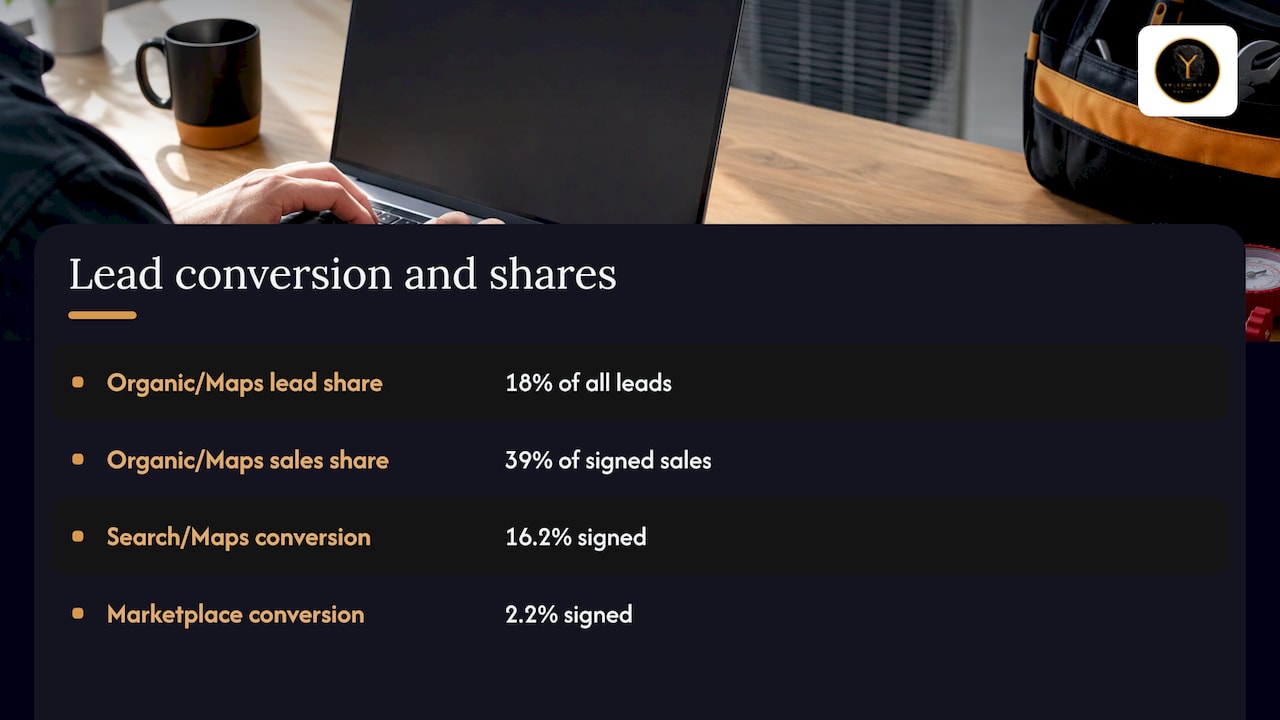
In Keystone’s three-year study of 16,724 home-improvement leads (September 2023 to August 2026), Google organic search and Maps produced 18% of leads but 39% of signed sales. Search and Maps leads signed at 16.2%, against 2.2% for purchased marketplace leads. The study is about home improvement broadly rather than HVAC alone, but the pattern is the point: a lead that found you is warmer than a lead that was sold to you.
The same study found that 62% of online inquiries arrived outside Monday to Friday, 8 a.m. to 6 p.m., and Sunday was the busiest day. A dead compressor does not wait for office hours. Your profile should show accurate emergency hours, and your phone or answering setup should be ready for the evening and weekend calls that search sends.
The website: what it should and should not contain
Most HVAC sites make the same mistake: a long list of “service + city” pages with the same text and the town name swapped. WEX FSM’s guide points out that Google’s spam policies describe doorway pages as pages made to rank for similar searches in different places, and that Google’s John Mueller has said a large set of service-plus-city pages sounds like exactly that.
A safer structure:
- One page per core service: AC repair, AC installation, furnace repair, heat pump installation, duct work, maintenance plans.
- A town page only when you have something real to put on it: completed jobs, typical home types in that area, photos and local reviews.
- Clear calls to action: click-to-call on mobile, a short request form and visible hours.
- Local intent language. ServiceTitan recommends targeting phrases such as “AC not cooling in Austin” or “emergency heater repair near me” because they match what a stressed homeowner types.
If your site is slow, dated or hard to use on a phone, SEO work is held back by the page itself. We also offer web design for that case, and it can be hired on its own.
Reviews: the loop that keeps rankings moving
WEX FSM describes a loop worth remembering: SEO brings calls, calls become jobs, jobs earn reviews, and reviews strengthen SEO. Its guide adds that recent reviews help local rankings, so a one-click review request after each completed service call keeps the loop turning.
Two habits matter most.
- Ask every satisfied customer, every time, while the technician is still on site or within hours of finishing.
- Reply to every review in plain, specific language. A short note about the repair that was done reads better than a template.
Ask the right way, too. Our piece on Google reviews and why paying for opinions backfires explains why a steady, honest review routine is the approach that lasts. Review systems are part of the monthly work we do.
Showing up in AI answers
Homeowners increasingly ask ChatGPT, Gemini, Perplexity or Google’s AI Mode who to call. In the ACHR panel, one speaker said AI platforms look for verifiable evidence to support a company’s claims. The advice that followed: make specific, checkable information available online, and keep current reviews on your own website, where AI tools are more likely to find them.
In practice that means consistent business details across the web, service pages that state exactly what you do and where, real project descriptions, and reviews displayed on your site. Our overview of AI search visibility services for local businesses explains what that work involves.
A bilingual layer for a mixed market
In Miami, Orlando, Tampa, Atlanta, New York or Philadelphia, a large share of the homeowners searching for AC repair do it in Spanish. Spanish searches use different words, and a translated English page rarely matches them. We work English and Spanish keywords, pages and content separately, so your business can appear for both the English-speaking and the Hispanic customer in your area. If your crew or office already speaks Spanish, this turns an existing strength into leads.
How to measure whether it works
SEO that cannot be checked is a risk. As contractor Hoover put it in the ACHR panel, clicks do not mean money; what matters is when the phone rings and people book.
Track these, in this order:
| Measure | Where to find it | What it tells you |
|---|---|---|
| Calls from your Business Profile | Business Profile performance | Whether the map listing drives phone leads |
| Form fills and click-to-calls from the site | Your analytics | Whether pages convert visitors |
| Booked jobs by lead source | Your scheduling or CRM system | Which channel pays |
| Review count and recency | Business Profile | Whether the loop is running |
| Map ranking in your service area | Rank report by neighborhood | Where you are visible and where you are not |
The last step is the one most contractors skip: asking the office how each call started. Booking rates differ widely between shops. ServiceTitan platform data cited in one 2026 evidence register put the average booking rate of inbound lead calls at 39% for most trades companies, against 62% for top performers. Better SEO sends more calls, and a well-handled phone turns them into jobs.
Timelines vary by market and starting point, so treat anyone who guarantees a date or a position with caution. We make no promises of ranking positions. We report monthly work that you can verify.
How to choose an HVAC SEO company
Ask these questions before you sign.
- What exactly is done each month? Look for named tasks: profile updates, content published, links earned, reviews handled, technical fixes. Vague promises are a bad sign.
- Who does the work, and where are they? A team in your time zone is easier to reach during your busy season.
- How is progress reported? You want calls, forms and booked jobs next to rankings, in plain language.
- Does the agency promise rankings? Nobody controls Google, and the platform itself says rankings cannot be bought.
- How many clients does it carry? A limited portfolio means your account gets real attention. That is deliberate at YellowRock.
- Is there a long lock-in? Ask for the contract terms in writing.
- Does it cover more than one language and more than one location? If you run several branches, our multi-location local SEO playbook shows how the work is organized.
The broader process is laid out in our guide to local SEO lead generation, which covers how searches become customers.
Where we fit
We are a local SEO agency for independent businesses across the United States, with a team based in the U.S. and a focus on the East Coast, including Miami, Fort Lauderdale, Orlando, Tampa, New York, New Jersey, Boston, Philadelphia, Washington D.C. and Atlanta. We work with home services businesses, among other local industries.
There are three plans. Starter covers the local SEO foundation. Growth adds bilingual SEO. Authority adds AI search visibility. If you want paid calls while organic work builds, Turbo Google Ads can be hired separately. Every engagement starts with a free SEO audit.

To see where your company stands in your service area, start with the audit on our site.
Our view on HVAC SEO
Most HVAC owners we talk to want one thing: the phone ringing with people who need a repair or an installation in their own area. Everything else is a means to that end.
We believe the work has to be done together. A polished Business Profile with a thin website leaves calls on the table, and a great website with few reviews gives Google little reason to put you in the top three. That is why our monthly work covers Google Business Profile, Maps, website SEO, weekly content with backlinks, reviews and AI search visibility as one system.
We also believe in being straight about results. We do not promise ranking positions. We give you monthly work you can verify and reporting you can follow, and we keep our client list limited so each business gets real attention.
And for contractors in markets where many homeowners search in Spanish, bilingual SEO is a practical advantage: separate keywords, pages and content for each language.
YellowRock
FAQ
How much do HVAC SEO services cost?
Prices depend on scope: how many services, areas and languages are covered, and whether content, reviews and ads are included. Our plans are quoted after the free SEO audit, so the figure fits your market. Compare any quote by what is done each month rather than by the headline price.
How long does HVAC SEO take to work?
It depends on your competition, your starting profile and your site. Profile fixes and review work can show up earlier than competitive organic rankings, which build over months. Track calls and booked jobs monthly instead of waiting for a fixed date.
Do I need SEO if I already get work from referrals?
Referrals and search work together. Homeowners often look up a recommended company before calling, and what they find, your reviews, profile and site, can decide whether they do. Strong search presence also catches the emergency searchers who have no one to ask.
Can a small HVAC company compete with bigger ones?
Yes, because local results weigh distance and relevance, not company size alone. A complete profile, steady recent reviews and a service area you actually cover can put a small contractor in the map results for its own neighborhoods.
Sources
- Tips to improve your local ranking on Google, Google Business Profile Help
- What Homeowners Expect When They Call an HVAC Contractor, ACHR News
- HVAC SEO Services: Local Search Guide for Contractors, WEX FSM
- Google Business Profile for HVAC: Full Guide, ServiceTitan
- Where home-improvement sales actually come from, Keystone
- SEO for HVAC Contractors, Ahrefs