

Real estate SEO services get your name in front of buyers and sellers at the moment they search Google, Maps and AI tools for a local agent, a neighborhood or a home value. The work has four parts: neighborhood-level keyword research, a Google Business Profile that earns map visibility, website pages and content that answer real questions, and reporting you can check each month. We are a local SEO agency, and for brokerages and agents who want seller and buyer leads without renting them from a portal, this is the approach we recommend. Done in English and Spanish where your market calls for it, it reaches more of the people who actually live in your service area.
Key Takeaways
- Real estate SEO wins on hyperlocal terms (neighborhoods, zip codes, “how much is my house worth in [city]”) rather than broad terms like “real estate agent”.
- Three pieces work together: your Google Business Profile, your website and content, and the reviews and local links that prove you are the agent for that area.
- AI search is moving early-stage research, so your pages should be clear, factual and specific enough to be cited, not just indexed.
- Judge any provider on deliverables, monthly reporting and honesty about timelines. Nobody can promise a ranking position.
- In bilingual markets such as Miami, Orlando, New York and Atlanta, separate English and Spanish pages capture searches that one-language sites miss.
Table of Contents
- What real estate SEO services actually include
- How real estate SEO works: the two places you can show up
- Keywords: win the neighborhood, not the country
- Content and lead capture that bring in sellers
- Reviews and local links
- SEO and AI search in 2026
- How long it takes, and what to expect
- How to choose a real estate SEO provider
- Where our plans fit
- Our perspective
- FAQ
- Sources
What real estate SEO services actually include
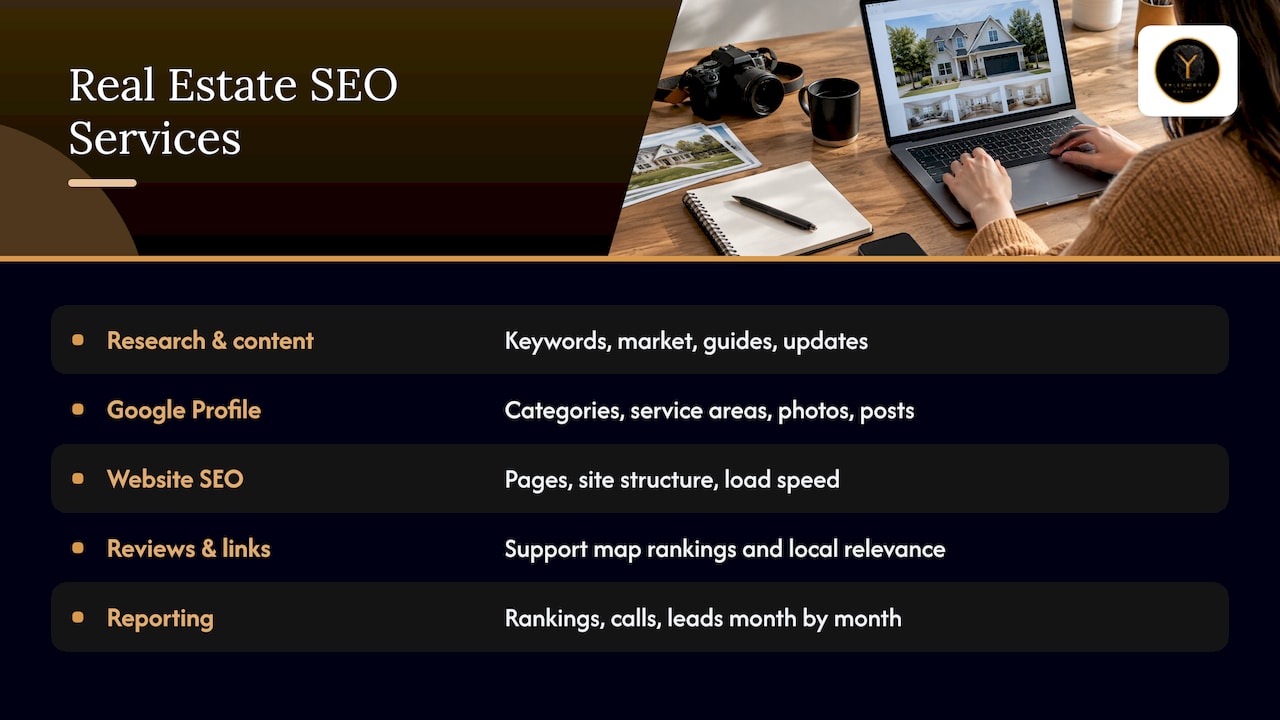
SEO (search engine optimization) is the work of making your business easier for Google to find, understand and trust. For an agent or brokerage, that breaks into a handful of deliverables.
Keyword and market research. Which phrases do buyers and sellers in your area type, and which can you realistically win? We cover the method in our guide to keyword research for real SEO opportunities.
Google Business Profile optimization. Your Business Profile is the listing that appears in the map results for searches like “real estate agent near me”. It needs accurate categories, service areas, photos, posts and a steady flow of reviews. Our 12-point Google Business Profile audit shows what gets checked.
Website SEO. Neighborhood pages, a seller page, a buyer page, agent bios, fast load times and clean site structure. The site has to be crawlable so Google can read it. Real estate sites often add structured data (code that labels your pages as an agent, a listing or a local business), which Inman’s 2026 analysis recommends along with FAQ markup, as it covers in its look at marketing after Google search.
Content. Neighborhood guides, market updates and answers to the questions clients ask you every week.
Reviews and local links. Reviews support map rankings, and links from local publications, chambers and community sites signal that you belong in that market.
Reporting. Rankings, calls, direction requests and form leads, shown month by month so you can see what the work produced.
How real estate SEO works: the two places you can show up
When someone searches for a local agent, Google can show two kinds of results. The first is the map pack, a block of three local businesses above the regular results. Search Engine Land’s real estate SEO guide advises prioritizing those three local-realtor spots for location-specific searches. The second is the standard organic listings, where your website’s pages compete.
The map pack is driven mostly by your Business Profile, reviews and proximity. Organic listings are driven by page quality, relevance and links. An agent who works both gets two chances to be seen on the same search, and that is why we run Business Profile, website and reviews together every month rather than as separate projects.
Keywords: win the neighborhood, not the country
A solo agent or small brokerage will not outrank national portals for “homes for sale”. You can beat them where they are thin: the specific places you know. Ahrefs’ guide to competing with big real estate sites points to hyperlocal targeting (neighborhoods, streets, landmarks, zip codes, city comparisons) and high-intent long-tail phrases as the two places smaller businesses can compete. You give up some search volume and get more qualified visitors in return.
HousingWire’s 2026 guide to real estate SEO lists the kinds of searches agents should mirror:
| Searcher | Typical search | Page that answers it |
|---|---|---|
| Buyer | Homes for sale in [city] | City or neighborhood buying page |
| Buyer | Best neighborhoods in [city] | Neighborhood guide |
| Seller | How much is my house worth in [city] | Home value page with a lead form |
| Either | Real estate agent near me | Business Profile and agent bio page |
| Seller | Is now a good time to sell a house | Seller Q&A post |
The same guide stresses matching the way real people search rather than stuffing terms into every paragraph. If a page answers the questions your clients ask you daily, you are already close.
Two practical points. First, seller intent is where the money is for most agents, so a home value page and a “selling in [neighborhood]” page deserve as much attention as listings pages. Second, keyword research differs by industry: a restaurant targets dish, cuisine and “open now” searches with a short decision window, while a real estate agent targets research-stage questions that unfold over weeks or months. That is why a real estate keyword plan is built around neighborhoods and life events, not menus and hours.
The bilingual layer
If you work in Miami-Dade, Orlando, Tampa, New York, New Jersey or Atlanta, a share of your buyers and sellers search in Spanish. Spanish searchers do not use word-for-word translations of English queries, so the Spanish page needs its own keywords and its own copy. We build English and Spanish keywords, pages and content separately for that reason. Our SEO for real estate agencies page describes how that applies to brokerages.
Content and lead capture that bring in sellers
Traffic only matters if it turns into a call or a form. A real estate page that earns leads usually has:
- A clear promise in the first lines (“What is your Brooklyn home worth?”).
- Local proof: recent sales areas, neighborhoods you know, short client results you can stand behind.
- A named agent with a photo and contact details. Ahrefs notes that a personalized agent section with contact details builds trust.
- One obvious action: call, text or a short form.
- Answers to common questions, written from the real conversations you have with clients.
The Search Engine Land guide recommends writing blog content from real questions people ask about your service area, which is the same idea. Our article on local SEO for real estate agencies goes deeper on attracting property owners.
Reviews and local links
Reviews do two jobs: they persuade the person reading them and they feed local rankings. Ahrefs lists customer service that earns positive reviews as one of the four ways smaller real estate businesses compete. Ask at the moment of closing, make it easy to leave a review from a phone, and respond to each one. Please avoid buying reviews; we explain the risks in our piece on Google reviews and paying for opinions.
Local links come from neighborhood associations, local news, sponsorships, partner businesses and community events. They are slow to earn and hard to fake. Our guide to local link building for neighborhood businesses lists realistic sources.
SEO and AI search in 2026
People now ask ChatGPT, Gemini, Perplexity and Google’s AI Mode where to live and who to hire. Inman’s May 2026 article reports that specific-business searches, the kind real estate and local services get, are less likely to trigger AI summaries. It also reports that early research, such as neighborhood and market questions, increasingly gets answered inside AI tools. The practical point is to be cited by those tools, not only listed by Google.
The realtor.com PRO team makes a similar point in its guide to SEO, AEO and GEO for agents: clear expertise, relevant local content, accurate business information and a crawlable website still matter, and good SEO is the foundation the newer disciplines build on. AEO (answer engine optimization) means structuring content so AI tools can quote it, and GEO covers generative AI search more broadly.
In practice, that means:
- Business name, address, phone and hours that match everywhere they appear.
- Pages that state which markets you serve and what you have done there.
- Short, direct answers to buyer and seller questions, with FAQ markup.
- A site that loads fast and is easy for crawlers to read.
How long it takes, and what to expect
SEO compounds. Early months go into fixing the profile, the site and the content plan; rankings and leads build after that. Be skeptical of anyone who names a specific ranking or lead number up front. Google’s own guidance for hiring an SEO says that if a provider guarantees first place in search results, you should find someone else. We make no promises of ranking positions; we commit to verifiable monthly work and transparent reporting.
A fair timeline discussion covers your market (a dense city like Miami is more competitive than a small suburb), your starting point (an existing site with reviews moves faster) and the deliverables planned for each month.
How to choose a real estate SEO provider
The same Google page gives sensible questions to ask any SEO provider. Adapted for an agent or brokerage:
- Ask for examples of previous work and for references you can call.
- Ask how they follow Google’s guidelines (Google Search Essentials).
- Ask what results to expect, in what timeframe, and how success is measured.
- Ask about experience in real estate and in your city.
- Look for interest in your business. A good provider asks what makes you different, who your competitors are and how clients find you.
- Be careful with access. For an audit, Google advises read-only access to Search Console at first, not write access.
Beyond that, compare what you receive each month: which pages were published, which profile changes were made, which links were earned and what the report shows. Our own approach is built around a deliberately limited client portfolio, so each business gets real attention, and a team with presence in the U.S. that works in your time zone.
Where our plans fit
Every engagement with us starts with a free SEO audit. From there we offer three plans, Starter, Growth and Authority. Starter covers local SEO. Growth is our bilingual SEO plan, built for agents and brokerages serving both English and Spanish speakers. Authority adds a focus on visibility in AI search. Web design and Turbo Google Ads can be hired on their own, with details on our web design page.

If your brokerage wants a plan that works Business Profile, website, reviews and AI visibility together each month, start with the free audit through our site.
Our perspective
Most agents we talk to are paying for leads they do not own. A portal can turn off the tap or raise the price, while a well-built local presence keeps working in your name.
We think the winning move for an independent agent or brokerage is to be the clear local answer: a complete Business Profile, a site with real neighborhood pages, honest reviews and content that answers what clients ask. We do that every month, together, because each piece lifts the others.
We also believe in doing it in both languages. A Spanish-speaking buyer in Hialeah or a seller in Union City is not searching with translated English, so we work English and Spanish keywords and content separately.
And we will not promise a position on Google. We promise visible work and clear reporting, so you always know what was done and what moved.
YellowRock
FAQ
How much do real estate SEO services cost?
Prices vary by provider and by scope, and ours are not published, so we quote after the free SEO audit based on your market and goals. Compare quotes by what is delivered each month, not by the headline number.
How long does real estate SEO take to work?
Expect it to build over months, not weeks. The first stretch fixes your profile, site and content plan, and visibility grows as pages, reviews and links accumulate. Any provider guaranteeing a position should be treated with caution.
Is SEO still relevant with AI search?
Yes. realtor.com PRO describes SEO as the foundation that AI-focused optimization builds on, and Inman reports that searches for specific businesses are less likely to trigger AI summaries. The goal now is to be findable and citable.
Do agents need a separate Spanish website?
Not necessarily a separate site, but Spanish pages with their own keywords and copy, written for how Spanish speakers search. In markets such as Miami, Orlando and New York this reaches buyers and sellers an English-only site misses.
Sources
- 6 steps to win at real estate SEO, Search Engine Land
- The Ultimate Guide to Real Estate SEO for Agents in 2026, HousingWire
- Real Estate SEO: 6 Things You Can Do to Compete With Big Sites, Ahrefs
- Real Estate Marketing In A Post-Google (Search) World, Inman
- SEO, AEO, and GEO for real estate, realtor.com PRO
- Do You Need an SEO? Tips for Hiring an SEO, Google Search Central