There is no separate trick for Google AI Overviews. Google’s own documentation says the same SEO fundamentals still apply: your page has to be indexed, eligible to show a snippet, and genuinely helpful. For a local business, that means three things working together every month: a complete Google Business Profile, a website that answers customers’ questions in plain text, and reviews and content that prove you are the real thing. At YellowRock Marketing, that combination is how we approach AI search visibility, in English and in Spanish.
Key Takeaways
- Google states that no special AI Overview markup or extra technical requirement exists. Indexed, snippet-eligible pages with helpful content are the entry ticket.
- For nearby searches, an accurate, complete Google Business Profile matters as much as your website, because Google ties local visibility to relevance, distance and popularity.
- Nobody can guarantee a citation. Be wary of anyone who promises one or claims to know secret AI ranking factors.
- Search Console now has a Generative AI performance report, so you can measure what AI features do for your site instead of guessing.
- If your customers search in English and Spanish, each language needs its own keywords and pages, not a translated copy.
Table of Contents
- What AI Overviews are and when they show up
- What Google says you need to do
- Why your Google Business Profile belongs in this conversation
- A practical plan for the first 90 days
- Local searches in English and Spanish
- What is proven and what is not
- How to measure AI Overview visibility
- Where AI search visibility fits in our plans
- Work with a team that handles the whole picture
- Our perspective
- FAQ
- Sources
What AI Overviews are and when they show up
An AI Overview is the AI-written summary that sometimes appears at the top of Google results. Google describes these summaries as a way to help people get the gist of a complicated topic or question, with links for going deeper. To build them, its systems may run “query fan-out”: searching several related subtopics and data sources behind one question, according to Google Search Central.
Two details matter for a small business owner.
First, AI Overviews do not appear for every search. Google says they show only when its systems decide they add benefit beyond classic results. A search like “emergency plumber near me” often goes straight to the map and listings, while “what should I do if my water heater leaks” is more likely to trigger a summary.
Second, being eligible is not the same as being shown. Google does not guarantee that any page will be selected as a supporting link. The goal is to become a strong candidate across many searches, not to chase one box.
What Google says you need to do
Google’s guide to optimizing for generative AI features is short on gimmicks and clear on basics. Here is what it supports, in order of how much it matters to a local business.
Be indexed and snippet-eligible
A page that Google cannot crawl, or that is blocked from showing snippets, cannot be used. Check that your key pages are indexed, that nothing in your robots settings or meta tags blocks them, and that your important information sits in real text. A menu that is only a PDF image, a price list inside a photo, or a service page built entirely from a slider all hide information from Google.
Publish helpful, original content
Google recommends people-first content that shows an original point of view and real experience, not recycled copy that says what every other site says. For a local business, original means things only you can write:
- A dental practice explaining what a first visit with a nervous child looks like in its own office.
- An HVAC contractor describing what Florida humidity does to a unit and how its technicians diagnose it.
- A restaurant describing the dish, the sourcing and the neighborhood behind its menu.
- A real estate agent explaining how closing works in a specific county.
Google also advises organizing content with clear paragraphs and headings and supporting text with relevant images or video.
Keep structure simple
Google says no special schema and no AI-specific machine-readable file is required. Structured data is still useful for Search generally, but it has to match what visitors can see on the page. Do not add markup for reviews, prices or hours that do not appear on the page itself.
Use internal links and crawlable paths
Link from your homepage and service pages to the pages that matter, with descriptive anchor text. A page that nothing links to is hard for Google to find and hard to treat as important.
Why your Google Business Profile belongs in this conversation
For a local business, the page Google cites is often not the only way you appear. Google’s guide notes that Business Profiles (and Merchant Center for product sellers) can help services and products show up in AI responses and other Search results.
Google’s help center explains how local ranking works: results are based mainly on relevance, distance and prominence. Relevance is how well your profile matches the search. Distance is how close you are to the person searching. Prominence reflects how well known you are, which reviews, links and mentions feed into. Google also says complete, accurate business information makes you more likely to appear in relevant local results.
In practice, a profile worth trusting has:
- The correct primary category and every secondary category that truly applies.
- Accurate hours, including holiday hours, and the same name, address and phone number as on your website.
- A services or menu section that uses the words customers actually use.
- Fresh photos taken at your location.
- Reviews that you answer, good and bad.
We built a Google Business Profile audit checklist that walks through twelve of these points, which is a good place to start before you touch anything else.
A practical plan for the first 90 days
Here is a sequence that fits a business with a physical location and a small team. It follows what Google says it rewards, and it works whether or not an AI Overview ever appears for your searches.
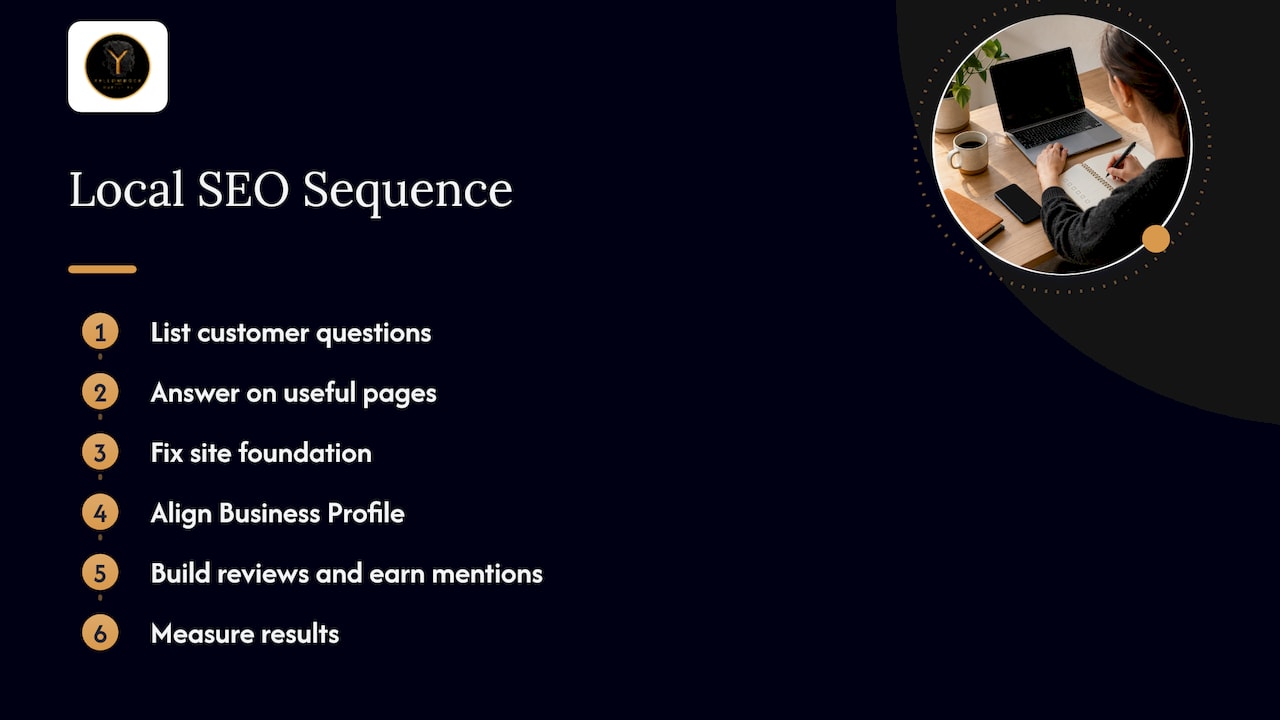
Step 1: List the questions customers ask
Write down the 20 questions your front desk, servers or technicians answer most. A med spa hears “how long does it last and how much downtime is there?” A veterinary clinic hears “do you take walk-ins for emergencies?” A law firm hears “how much does a consultation cost?” These are the searches where summaries tend to form, and they are also the questions your competitors rarely answer well.
Step 2: Answer each question on a page that deserves to be cited
Put the answer in the first few sentences under a clear heading, then add the detail: price ranges you are willing to share, process, what to bring, how long it takes, who does the work. Write it the way you would explain it to a customer standing in front of you. Lead with the answer, then give the proof.
Avoid inflating pages with filler to hit a word count. Google’s stated focus is helpfulness and original experience, not length.
Step 3: Fix the foundation
Confirm that service pages load fast on a phone, that each location has its own page with the address and a map, and that important facts are text and not images. If your site is a slow template that hides information, a rebuild may do more for you than any new content. Our web design service exists for that case.
Step 4: Make your profile match your website
Compare your Business Profile with your site line by line: name, categories, hours, services, phone. Mismatches weaken the picture Google has of your business. Then post updates and photos on a regular schedule.
Step 5: Build reviews as a system
Reviews feed prominence, and they supply the real-customer language that makes your business look credible. Ask every satisfied customer, at the moment they are happiest: after the meal, after the appointment, after the closing. Reply to every review. Make it a routine for one person, not an occasional push.
Step 6: Earn mentions beyond your own site
Local press, chamber of commerce listings, neighborhood associations, supplier directories and partner businesses all signal that you exist in the real world. Prioritize relevant, local sources over bulk directory submissions.
Step 7: Measure and adjust
Check results monthly, as the next section explains.
Local searches in English and Spanish
In Miami-Dade, Orlando, Tampa, New York, New Jersey, Philadelphia and Atlanta, a large share of your potential customers search in Spanish, in English, or both depending on the need. People do not always type the translation of an English phrase. “Dentista de emergencia cerca de mí” and “emergency dentist near me” are different searches with different results, and a page that mixes both languages usually serves neither well.
The approach that holds up:
- Research Spanish keywords separately, including regional wording that differs between communities.
- Build dedicated Spanish pages with natural, native-quality copy.
- Keep your Business Profile’s description, services and replies to reviews consistent with the languages your customers use.
- Collect and answer reviews in both languages.
This is the core of how we work: English and Spanish keywords, pages and content are handled separately, so a business can appear for both the English-speaking and the Hispanic customer in its area. Our Growth plan is built around that bilingual approach.
What is proven and what is not
The AI optimization market is crowded with confident claims. Google’s guidance helps sort them.
| Tactic | What the evidence says |
|---|---|
| Indexed, crawlable, snippet-eligible pages | Required by Google |
| Helpful, original, people-first content | Recommended by Google |
| Accurate, current Business Profile | Supported by Google for local visibility |
| Special “AI schema” or an AI-only file | Google says neither is needed |
| Guaranteed citations in AI Overviews | Not something anyone can promise, since Google does not guarantee selection |
| Secret AI ranking factors sold by vendors | Google notes that outside vendors cannot see its internal AI ranking metrics |
There is also a useful correlation worth knowing. Search Engine Land reports that strong conventional rankings tend to go along with AI Overview citations, citing a study with a 53% citation probability for first-position links against 36.9% for tenth-position links. It is not a guarantee, but it supports the idea that solid local and organic SEO is the base layer, not something AI replaces.
How to measure AI Overview visibility
Google points site owners to the Generative AI performance report in Search Console, which shows how people discover your content through Google’s generative AI features. If you have not verified your site in Search Console, do that first. Then, each month:
- Note which pages appear in the report and which queries are involved.
- Compare clicks and impressions on those pages over several months, not weeks.
- Check the Business Profile insights for calls, direction requests and website clicks.
- Count the leads that matter: reservations, booking requests, consultations, quotes, new patients.
- Run a handful of your priority searches yourself, in English and Spanish, from a phone, and record what appears.
Keep expectations realistic. The data covers only what Google reports, and AI results can vary by person, location and day. The business outcome, meaning calls, bookings and walk-ins, is the number that counts. We report on verifiable monthly work, and we make no promises of specific ranking positions.
Where AI search visibility fits in our plans
AI answers also come from tools beyond Google, such as ChatGPT, Gemini and Perplexity. The habits are the same: clear answers, consistent business information and genuine reputation. If you want to see how we cover those engines, read about our AI search visibility services and our generative engine optimization services. For the lead side of the equation, our guide to local SEO lead generation shows how searches turn into customers.
Work with a team that handles the whole picture
Optimizing for AI Overviews is not a single task. It touches your Business Profile, Google Maps position, website, content, reviews and measurement, and each of them needs attention every month. YellowRock Marketing is a local SEO agency for independent businesses across the United States, with a team in the U.S. working in your time zone and a deliberately limited client portfolio so each business gets real attention. Our Authority plan covers AI search visibility, and every engagement starts with a free SEO audit.
To see all the options, including Starter, Growth, web design and Turbo Google Ads, visit our services overview or start from the YellowRock homepage.
Our perspective
Most owners ask us whether AI Overviews are a new channel they have to learn from scratch. We think the better question is whether the basics are in place, because Google itself says they are what counts.
A restaurant in Tampa, a dental office in Orlando or a brokerage in Boston wins nearby customers when the profile is accurate, the website answers real questions, the reviews are steady and the information matches everywhere. When that work is done in both English and Spanish, with separate keywords and content for each, the business is visible to customers that many competitors never reach.
That is why we work Google Business Profile, Maps, website SEO, content, reviews and AI search together every month, and why we report the work we did so you can verify it. We do not promise ranking positions or citations, because nobody controls them. We promise steady, visible work and attention from a team that keeps its client list small.
YellowRock
FAQ
Do I need a special strategy to appear in Google AI Overviews?
Not a separate one. Google says there are no extra technical requirements or special optimization for AI Overviews beyond being indexed and eligible for a snippet. Strong fundamentals, helpful content and an accurate Business Profile are the foundation.
Can anyone guarantee that my business will be cited?
No. Google states that an eligible page is not guaranteed to be selected, and that outside vendors cannot see its internal AI ranking metrics. A trustworthy provider commits to the work and the reporting, not to a result Google controls.
Does my Google Business Profile affect AI answers for nearby searches?
Google says Business Profiles can help services be visible in AI responses and other Search results, and that complete, accurate information makes a business more likely to appear in relevant local results. Keep your categories, hours, services and photos current and consistent with your website.
How do I track whether this is working?
Use the Generative AI performance report in Search Console, your Business Profile insights, and your own lead counts such as calls, bookings and consultations. Review them monthly over several months to see a trend.
Sources
- AI Features and Your Website, Google Search Central
- Google’s Guide to Optimizing for Generative AI Features on Search
- Tips to improve your local ranking on Google, Google Business Profile Help
- AI Overviews optimization guide, Search Engine Land