

PPC management in New York means someone builds, runs and improves your paid search campaigns every week, so each ad dollar brings calls, bookings or sales from the neighborhoods you serve. Most agencies charge either a flat monthly fee or a percentage of ad spend, and that fee is separate from what you pay Google. Below you’ll find what the work covers, how pricing works, what to set up first, how often to review results and how to judge an agency’s reporting.
Key Takeaways
- Good PPC management covers account setup, conversion tracking, keyword and negative keyword control, ad testing, geographic targeting and monthly reporting in plain language.
- Agency fees and ad spend are two separate budgets. Ask for both numbers in writing before any work starts.
- Judge a campaign by profit and lead quality, not by clicks or ROAS alone.
- You should own the Google Ads account and be able to see every change made to it.
- In a city as dense as New York, location targeting and a strong Google Business Profile decide whether paid clicks turn into customers.
Table of Contents
- What PPC management includes for a New York business
- Google Ads management versus multi-platform PPC
- What PPC management costs in New York
- What to set up before an agency starts
- Metrics that show a campaign is profitable
- How often campaigns should be reviewed
- How to evaluate an agency before you hire
- New York specifics worth planning for
- Our perspective
- Where paid search and local SEO work together
- Work with YellowRock
- FAQ
- Sources
What PPC management includes for a New York business
PPC stands for pay-per-click: you bid for placement on Google Search, Maps, YouTube and partner sites, and you pay when someone clicks. Management is everything that happens around those clicks. For a local business, a solid scope usually has these parts:
- Account structure and keyword research. Campaigns grouped by service or product line, with keywords that match what a nearby customer actually types. In a city with five boroughs, that often means separating a Brooklyn dentist’s “emergency dentist” searches from a Manhattan office’s.
- Conversion tracking. Phone calls, form fills, direction requests and online orders are recorded as outcomes, so the account learns what a real lead looks like.
- Ad copy and extensions. Headlines, descriptions, call buttons, location details and sitelinks, tested against each other over time.
- Landing pages. The page a click lands on has to match the ad and make the next step obvious on a phone.
- Bid and budget control. Spend moves toward the hours, devices, areas and keywords that bring customers.
- Negative keywords and search-term review. Searches that waste budget get blocked. Google’s own documentation on Google Ads is the place to learn the mechanics of each setting.
- Reporting. A monthly summary of spend, leads, cost per lead and what changed.
The work is ongoing. An account set up once and left alone drifts, because competitors, seasons and search behavior move.
Google Ads management versus multi-platform PPC
People use “PPC” and “Google Ads” as if they were the same thing. They overlap, but they aren’t identical.
Google Ads management focuses on one platform and on intent: someone types “plumber near me” or “family dentist Queens” and sees your ad. For businesses with a physical location, this is usually where the demand is clearest, because the customer is already looking.
Multi-platform PPC adds channels such as Meta, LinkedIn, Microsoft Advertising or Amazon. Those channels work differently. Social platforms interrupt people who weren’t searching, so creative and audience choice matter more than keywords. Each platform has its own tracking, its own reporting and its own learning curve.
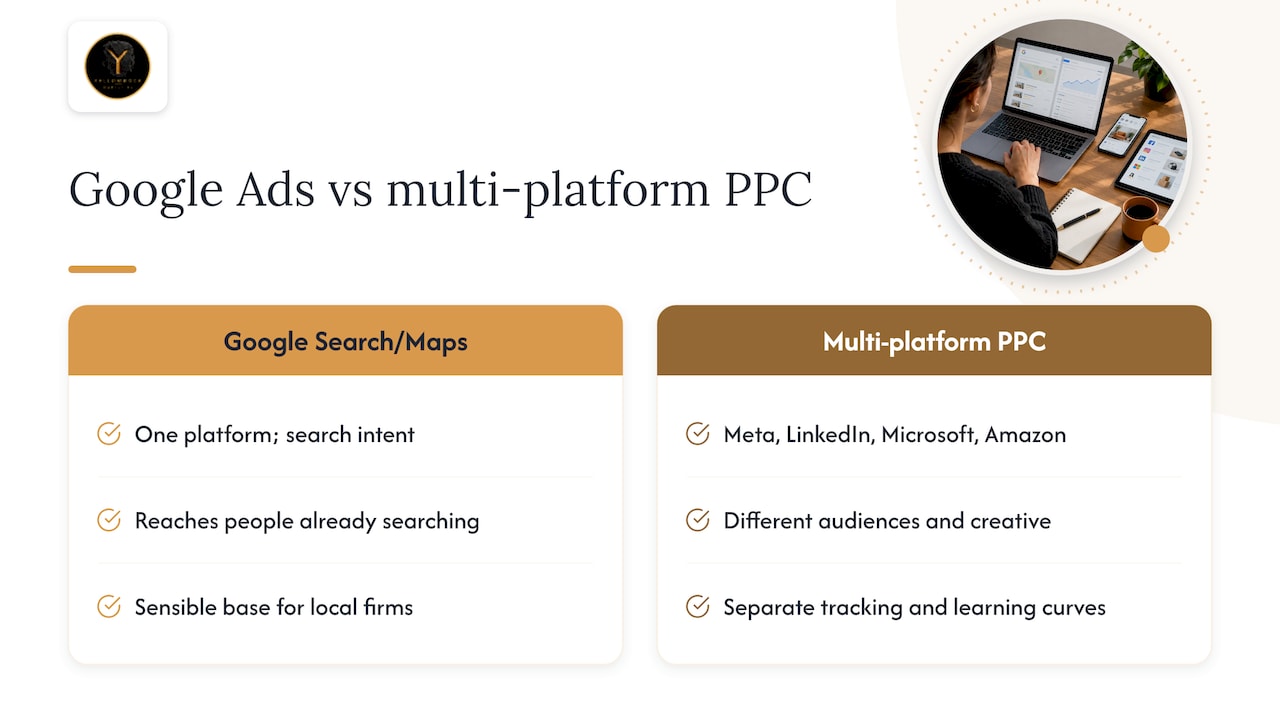
For a restaurant, clinic, salon, law firm or home services company in New York, starting with Google Search and Maps ads is the sensible base. You can add other platforms once the first one produces predictable leads and you know your cost per customer.
What PPC management costs in New York
There is no official New York price list for ad management. Pricing is set by each agency, so treat any figure as a range to compare against quotes, not as a rule.
One 2026 guide to search marketing costs reports that the common model is a percentage of monthly ad spend, often 10 to 20 percent, with many agencies setting a minimum monthly fee around $500. The same guide lists flat retainers for smaller accounts between $500 and $5,000 a month, and hourly consulting from $75 to $250 or more. Since agencies publish their own rates and the guide is a secondary source, use these numbers to sense-check quotes rather than to budget to the dollar.
What matters more than the model is what you can see. Ask every agency:
- What is the management fee, and how is it calculated?
- What is the recommended ad budget, and is it paid directly to Google from your own card?
- Are there setup fees, creative fees or landing page costs?
- What is the contract length, and how do you cancel?
- Who does the work: a named specialist or a rotating junior team?
A percentage fee rises when you spend more, which can be fair when the workload grows. A flat fee is easier to predict. Neither is better by default; clarity is.
Why New York clicks cost what they cost
Competition drives price. Legal, medical, real estate and home service keywords in dense metros are bid on by many advertisers, and Google’s auction rewards relevance as well as bid size. That is why careful targeting and tight ad-to-page match often beat simply raising the budget: you pay less for the same click when your ad and page are clearly relevant to the search.
What to set up before an agency starts
The first weeks go faster, and cost you less, when the groundwork is ready. Gather these before kickoff:
- Account ownership. Create or confirm your own Google Ads account and invite the agency as a manager. The account, its history and its data stay yours if you ever part ways.
- Business facts. Services you want more of, your best-margin jobs, service areas, opening hours and anything you don’t offer.
- Conversion goals. Decide what counts: a booked appointment, a phone call over 60 seconds, an online order, a quote request.
- Call and form handling. Someone has to answer the phone and reply to forms quickly. Paid leads cool fast.
- A working website. Fast on mobile, clear phone number, one obvious action per page.
- A healthy Google Business Profile. Ads can show your location, reviews and call button, so an accurate profile makes them stronger. Our Google Business Profile audit checklist walks through the 12 points worth checking first.
- Budget and margin numbers. What does a customer pay you, and what can you afford to pay to win one?
That last item is the foundation of everything else. If an average new patient or job is worth $400 to you and a quarter of leads become customers, you can work out a target cost per lead from there.
Metrics that show a campaign is profitable
Clicks and impressions are easy to report and easy to inflate. The numbers that tell you whether the campaign works are different.
| Metric | What it tells you | Watch out for |
|---|---|---|
| Cost per lead | What you pay for each call, form or booking | Low-cost leads that never buy |
| Lead-to-customer rate | How many leads become paying customers | Needs your own tracking, not just the ad account |
| Cost per customer | Ad spend divided by customers won | Compare it with the customer’s value to you |
| Conversion rate | Share of visitors who take action | A drop often points to the landing page |
| ROAS | Revenue per ad dollar | Revenue is not profit |
| Impression share | How often you show when you could | Lost share from budget or rank points to the next fix |
ROAS deserves a closer look. Search Engine Journal’s PPC KPI guide points out that revenue isn’t profit: a campaign showing 600% ROAS can lose money if fulfillment, discounts or shipping eat most of the revenue, while a 300% ROAS campaign can earn more if it sells higher-margin items. The same guide stresses incrementality, meaning whether a sale happened because of the ad or would have happened anyway.
For a local business, the practical version is simple. Track calls and bookings, tag them by source, and once a month compare ad spend with the revenue from the customers those leads became. If your branded searches (people typing your own name) make up most of the conversions, ask for brand and non-brand results reported separately, so you can see what the ads add beyond people who already knew you.
How often campaigns should be reviewed
There is no single official schedule, but a workable rhythm for a local account looks like this:
- Weekly: search terms, spend pacing, new negative keywords, call and form volume, any disapproved ads.
- Every two to four weeks: ad copy tests, bid and budget shifts, location and schedule adjustments, landing page tweaks.
- Monthly: a written report with results against your goals, what changed, why it changed and what happens next.
- Quarterly: a bigger look at structure, new services to promote, seasonal planning and budget level.
Avoid constant tinkering too. When an account uses automated bidding, big changes to targets or structure can reset how the system learns, so good managers batch changes and let data build between them. A report should explain every meaningful change in plain words: what was done, what the reason was and what result followed.
How to evaluate an agency before you hire
You don’t need technical knowledge to judge an agency. You need to ask for things a good one will show you easily.
Access and transparency
- You own the ad account and have admin access.
- You can see the change history, which records edits in the account.
- Fees, contract length and cancellation terms are in writing.
- Ad spend goes straight from your card to Google.
Tracking and reporting
- Conversions reflect real business outcomes, such as completed calls, bookings or purchases, not page views or soft actions.
- Results are split between brand and non-brand searches.
- Reports show cost per lead and cost per customer, not just clicks and impressions.
- Someone explains the numbers on a call, not just by emailing a PDF.
Day-to-day work
- They review search terms regularly and add negative keywords.
- They test ad copy and show you the results.
- They set geographic targeting to the areas you really serve, not an entire state.
- They don’t promise a ranking position or guaranteed results. Paid auctions can’t be guaranteed by anyone but Google.
Fit for your business
Ask for experience in your type of business. A restaurant in the East Village and a roofing contractor in Staten Island need very different campaigns. Ask who your point of contact will be, what time zone they work in and how quickly they reply.
A useful test of any agency is how it explains its work. If you leave the first call knowing what will happen in month one, month two and month three, that’s a good sign.
New York specifics worth planning for
New York is several markets in one. A few local points shape how campaigns are built:
- Neighborhood targeting. People search for services close to where they are, and a customer in Astoria is unlikely to cross town for a haircut. Radius and area targeting should follow the places you realistically serve.
- Mobile and “near me” intent. Many local searches happen on phones, often while walking or commuting. Click-to-call and clear hours matter.
- Language. The city is multilingual. If your customers search in Spanish, separate Spanish campaigns, ads and landing pages usually serve them better than translating English ones. We build English and Spanish keywords and pages separately for that reason.
- Seasonality. Restaurants, hotels, real estate and home services all see sharp swings through the year. Budgets and messaging should shift with them.
- Reviews. Your star rating and review count sit beside your ads and your map listing. Paid traffic converts better when the listing behind it is trusted.
Our perspective
We see paid search and local SEO as one system. A customer who clicks your ad on Tuesday may check your Google Business Profile on Wednesday, read your reviews, and call on Thursday from the map listing. If those pieces don’t agree, you pay for the click and lose the customer.
That’s why we start with a free SEO audit, look at the profile, the website and the search results together, and then decide where paid ads fit. For businesses that need leads quickly, our Turbo Google Ads service is designed to get campaigns live and producing while the longer-term organic work builds underneath.
We work in English and Spanish, with separate keywords and content for each language, because a bilingual market isn’t served by one translated campaign. We don’t promise ranking positions. We promise verifiable monthly work and reporting you can read, from a team with presence in the U.S., working in your time zone, with a deliberately limited client portfolio so every account gets real attention.
YellowRock
Where paid search and local SEO work together
Paid ads buy visibility today. Local SEO, meaning your Google Business Profile, Maps ranking, website and reviews, builds visibility you don’t pay for per click. The best results for a physical business come from both working on the same keywords and the same neighborhoods.
If you’re starting from zero, a practical order is:
- Fix the Google Business Profile so your name, address, hours and services are right.
- Launch a focused Google Ads campaign on your two or three most profitable services.
- Use the search-term data from the ads to learn which phrases bring customers.
- Feed those phrases into your website pages and content.
- Build reviews steadily so both ads and map listings convert better.
Our article on local SEO strategy for ranking on Google Maps covers the organic side in more detail.
Work with YellowRock
If you want quick leads from Google Ads alongside steady local visibility, our Turbo Google Ads service is built for businesses with a physical location. It can be hired on its own, without a monthly SEO plan. If you want paid and organic worked together, in English and Spanish, you can see all our local SEO, Google Ads and web design services. We don’t publish prices for these services, so the quickest way to get a clear scope and quote is to start with the free audit.

If your site needs work before ads can pay off, our web design service covers that too.
FAQ
How much should I spend on PPC in New York?
Start from your numbers: what a customer is worth, what share of leads close and what you can pay to win one. Agency fees and ad spend are separate, and one 2026 guide cites common agency minimums around $500 a month. Ask for a recommended ad budget and the reasoning behind it before you commit.
Is PPC management worth it for a small local business?
It can be when your customers search on Google before they buy and each customer is worth more than the cost to win them. Local services, clinics, restaurants and professional practices fit that pattern. Track calls and bookings from day one so you can see the return in your own numbers.
How long before PPC campaigns produce results?
Ads can start showing and getting clicks within days of launch. Improvement usually comes over the following weeks as the account collects data on which searches, ads and pages convert. Expect the first month to be about learning, then judge progress against your cost-per-lead and cost-per-customer targets.
Should I choose an agency in New York or one elsewhere?
Location matters less than local knowledge, time zone and communication. Ask whether the team understands your neighborhoods and customers, works in your hours and can show examples from businesses like yours. A team that answers quickly and reports clearly is worth more than a nearby office.
Can I run PPC in Spanish and English?
Yes, and for many New York businesses it’s worth doing. Separate campaigns with their own keywords, ads and landing pages let each audience see messaging written for them. Ask any agency how it handles keyword research and ad copy in each language.
Sources
- Search Engine Marketing Cost: CPC, Budgets, and Fees (LegalClarity, 2026)
- The 8 Most Important PPC KPIs You Should Be Tracking (Search Engine Journal)
- Google Ads Help