

Generative engine optimization (GEO) services improve how AI search tools find, understand and mention your business when they write answers in Google AI features, ChatGPT, Gemini or Perplexity. For a local business, the work comes down to four things: a strong Google Business Profile, clear and crawlable web pages, consistent mentions and reviews, and honest measurement over time. Nobody can guarantee a mention. A good provider shows you the monthly work and the trend.
Key Takeaways
- GEO and AEO are labels for work that improves visibility in AI search. Google says optimizing for generative AI search is still SEO from its perspective.
- Real GEO services cover your Business Profile, page structure, direct-answer content, reviews, third-party mentions and repeated measurement.
- AI answers change from run to run, so one screenshot proves nothing. Ask for results reported as ranges over time.
- Local businesses have an edge: Google says Business Profiles can make products and services visible in AI responses.
- Be wary of any promise of guaranteed placement in AI answers.
Table of Contents
- What generative engine optimization means
- How GEO relates to traditional SEO
- What generative engine optimization services typically include
- How AI visibility is measured, and why one screenshot proves nothing
- What to realistically expect
- How to choose a GEO provider
- Our perspective
- Where our plans fit
- A simple 30-day starting plan
- FAQ
- Sources
What generative engine optimization means
When someone asks an AI tool “Which dentist near me takes walk-ins?”, the tool does not show ten blue links and stop. It retrieves sources, combines them and writes an answer. GEO is the work of making your business one of the sources it trusts and names.
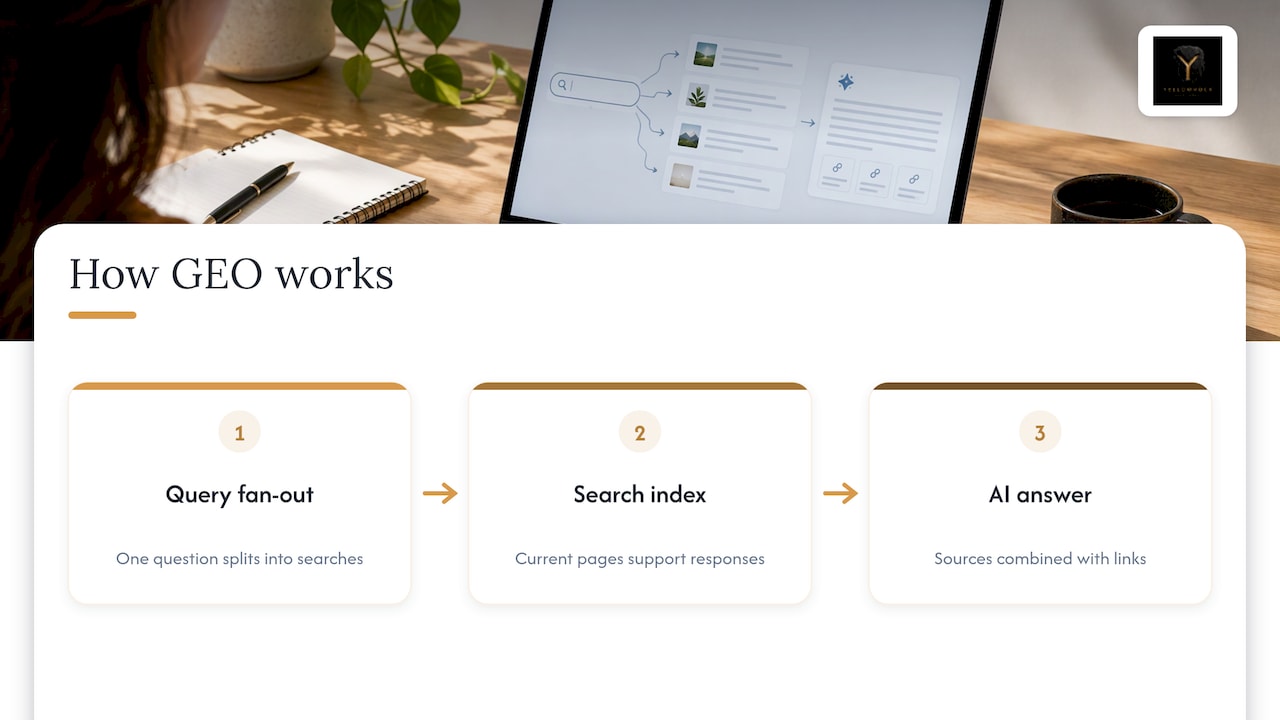
Google’s own guidance says GEO and answer engine optimization (AEO) are terms for work focused on improving visibility in AI search experiences. It also explains that its generative features use query fan-out: a single question is split into related searches, and relevant, current pages from the Search index are used to build a response with supporting links.
Other industry guides describe the goal the same way. One says GEO aims to get a brand noticed and accurately represented in AI-generated answers, even when no click follows. That last point matters. You may be recommended without a visit being recorded.
“Generative search optimization,” “AI SEO” and “optimizing for AI answers” are all the same idea under different names. Don’t let the vocabulary decide whom you hire. The work should decide.
How GEO relates to traditional SEO
Google states that its generative AI features are rooted in core Search ranking and quality systems. A page also has to be indexed and eligible to appear with a snippet to qualify for those features, and meeting the requirements does not guarantee crawling, indexing or serving.
The practical reading: GEO is built on top of SEO, not instead of it. If your site is not indexed, your pages are thin, or your Business Profile is half empty, no AI-specific tactic will rescue you.
There are real differences in emphasis. A comparison of GEO and SEO notes that SEO mainly targets rankings, clicks and traffic, while GEO emphasizes inclusion and citation in generated responses, brand mentions and share of voice. The same comparison finds plenty of overlap: quality, structured content, topical authority, original research and clear answers.
| Traditional SEO | GEO | |
|---|---|---|
| Main goal | Rank pages, earn clicks | Be included and cited in generated answers |
| Typical scorecard | Positions, traffic, calls | Mentions, citations, share of voice, plus calls |
| Foundation | Indexed, useful, authoritative pages | The same, plus clear answers and consistent mentions elsewhere |
| Local lever | Google Business Profile, Maps, reviews | The same signals, read by AI systems |
What generative engine optimization services typically include
Providers package the work differently, but a serious engagement usually covers the following. Use it as a checklist when you compare proposals.
1. An AI visibility audit
The starting point is finding out what AI tools say about you today. The U.S. Chamber of Commerce suggests asking AI tools questions such as what your company is, who founded it and which companies lead your industry, then checking whether the answers are accurate, outdated or incomplete. A proper audit does this across several tools and many phrasings, and records the results.
2. Google Business Profile and local signals
For a business with a physical location, this is the center of gravity. Google says Business Profiles can help local businesses make their products and services visible in AI responses and in other Search results. That means complete categories, services, hours, photos, posts, questions and answers, and review replies.
3. Technical eligibility and structured data
Pages must be crawlable, indexed and able to show a snippet. Google documents that LocalBusiness structured data can communicate details such as business hours, departments and reviews, and support prominent business information in Search and Maps. A GEO service should implement and validate this, not just mention it.
4. Answer-ready content
The Chamber’s small-business guidance recommends conversational phrasing, direct answers and concise summaries backed by verifiable facts, plus schema, metadata and clear headings. In practice: a service page that opens with a plain answer, a FAQ written the way customers actually ask, and pricing or process details stated clearly. Our guide to turning content into the engine of your SEO covers formats and frequency.
5. Reviews and third-party mentions
AI tools draw on more than your own site. Recent reviews with replies, consistent business details across directories, and mentions from local publications and industry sites all help a system confirm that you are real, active and relevant. This is the same groundwork as local SEO, which is why the two should be run together.
6. Human review of everything produced
Automation can speed up production, but Google says automatically generated content should be manually fact-checked because generative models can produce inaccuracies, including in metadata, structured data and image alt text. If an agency pushes out AI-written pages in bulk with no editor, you are paying to publish errors under your name.
7. Repeated measurement and reporting
This is where weak services get exposed. See the next section.
How AI visibility is measured, and why one screenshot proves nothing
AI answers are not stable. A 2026 academic study, “Don’t Measure Once,” found that the overlap of cited sources between consecutive days was only 34 to 42 percent, and the overlap of brand sets was 45 to 59 percent. It recommends measuring stability as well as visibility, using repeated runs instead of a single prompt.
The Interactive Advertising Bureau reaches a similar conclusion in its 2026 framework: AI platforms are nondeterministic, so identical queries can return different brands, sources and framing, and a single response per query is not enough. It calls for repeated responses, a documented variability baseline, controls for geography and timing, and results reported as ranges rather than single numbers.
The metrics worth asking for, per an industry guide to GEO, are AI mentions, impressions, AI share of voice, citations and AI-driven traffic. That guide also notes that AI-driven traffic is relatively small and often poorly attributed. So pair these numbers with the outcomes you already track: phone calls, direction requests, bookings, form fills and new patients or customers.
When a provider shows you a report, check four things:
- Were prompts run many times, not once?
- Do the prompts reflect how your local customers ask, including your city and neighborhood?
- Is the result a range or trend, not a lucky snapshot?
- Is the work done each month listed next to the numbers?
What to realistically expect
Here is the honest picture, built from the sources above.
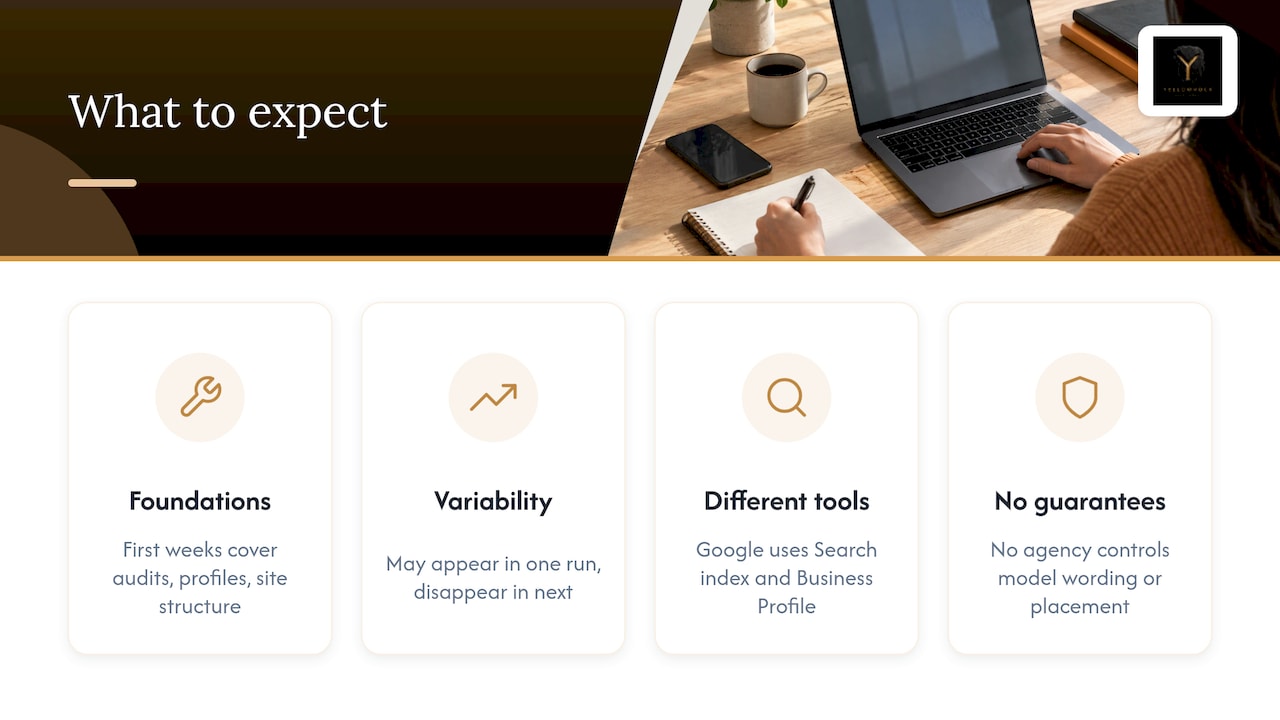
Expect foundations first. The first weeks go to the audit, fixing the Business Profile, cleaning up site structure and structured data, and rewriting key pages so they answer questions directly. Google notes that meeting its requirements does not guarantee crawling, indexing or serving, so improvement is a matter of raising your odds.
Expect variability. Your business may be named in one run and missing in the next. Progress shows up as a rising share of runs where you appear, not a fixed position.
Expect different tools to behave differently. Google’s AI features draw on the Search index and Business Profile data. Other assistants lean more on crawlable web pages and what others say about you elsewhere, so you need both your local listings and readable web content in good shape.
Expect no guarantees. Nobody controls what a language model writes. Any agency promising a specific placement in ChatGPT or Google AI answers is promising something it cannot deliver. We don’t make that promise, and neither should anyone you hire.
How to choose a GEO provider
Skip the ranking lists and judge the provider on these points:
- Local fluency. Do they work on Business Profiles, Maps and reviews, or only on brand-level content for national companies? A neighborhood restaurant and a software company need very different work.
- Clear deliverables. You should be able to read what was done last month: pages updated, profile changes, reviews handled, mentions earned.
- Honest measurement. Repeated runs, ranges, and outcomes you recognize.
- Editorial control. Human fact-checking of anything published, in line with Google’s guidance.
- Language coverage. If your customers search in English and Spanish, the provider should research and write for each language separately, not machine-translate one set of pages.
- No ranking promises. Positions in AI answers cannot be guaranteed.
- Flexible scope. Ideally GEO sits inside a broader local SEO plan, because the foundations are shared.
For more on the foundations, see our guides to on-page SEO and keyword research. If you plan a new site, redesigning without losing traffic protects the pages AI tools already rely on.
Our perspective
We treat AI search visibility as local SEO with a wider audience, not as a separate trick. The businesses we work with, such as restaurants, clinics, dental practices, hotels, med spas, home services and shops, win when a nearby customer is ready to buy. Increasingly that customer asks an assistant first.
That is why we work Google Business Profile, Google Maps, website SEO, content with backlinks, reviews and AI search visibility together every month. Each one feeds the others. A complete profile and fresh reviews help in Maps and give AI systems something reliable to repeat. Clear pages give them something to cite.
Our difference is bilingual SEO. We research and build English and Spanish keywords, pages and content separately, because a Spanish-speaking customer in Miami or Newark asks a question differently from an English-speaking one, and AI tools answer in the language of the question.
We do not promise ranking positions or guaranteed mentions. We keep our client portfolio deliberately limited so each business gets real attention, we work in your time zone with a team based in the U.S., and we report the monthly work transparently so you can verify it.
YellowRock
Where our plans fit
If you want AI search visibility handled as part of a full local program, our Authority plan is built around it. If you serve both English- and Spanish-speaking customers, the Growth plan covers bilingual SEO. If you are starting with the basics, the Starter plan is the entry point. Every engagement begins with a free SEO audit, so you see where you stand before deciding anything.
Need a faster start on lead flow while the organic work builds? Turbo Google Ads can be hired on its own, and so can web design. You can also see all our services or start from our homepage.
A simple 30-day starting plan
You can begin before you hire anyone.
- Week 1: Audit. Ask three or four AI tools the questions customers would ask, with your city in them. Note whether you appear and whether the facts are right.
- Week 2: Profile. Complete every field in your Google Business Profile, check categories and hours, add current photos and answer reviews.
- Week 3: Pages. Make sure your key service pages are indexed, open with a direct answer, and carry accurate LocalBusiness structured data.
- Week 4: Mentions. Check that your name, address and phone match across directories, and ask recent customers for honest reviews.
Then repeat the audit monthly with the same questions, several runs each, and compare ranges instead of single answers. That habit alone puts you ahead of most businesses.
FAQ
What is generative engine optimization?
It is the work of improving how often and how accurately AI search tools mention and cite your business when they generate answers. Google describes GEO and AEO as labels for work aimed at visibility in AI search experiences. In practice it builds on solid SEO, local listings, reviews and clear content.
Is GEO different from SEO?
The foundations are the same, and Google says optimizing for generative AI search is still SEO from its side. The difference is the scorecard: GEO tracks mentions, citations and share of voice in generated answers alongside traffic and leads.
Can an agency guarantee I will appear in ChatGPT or Google AI answers?
No. AI answers vary between runs, and eligibility for Google’s features is never guaranteed by meeting requirements. A trustworthy agency commits to specific monthly work and transparent reporting, and shows progress as ranges over time.
Does a local business need GEO services?
If customers near you ask assistants for recommendations, your visibility there matters. Start with your Google Business Profile, accurate pages and reviews, since Google says Business Profiles can help local businesses show up in AI responses.
Sources
- Google’s Guide to Optimizing for Generative AI Features on Search
- Google Search’s Guidance on Generative AI Content
- Local Business (LocalBusiness) Structured Data
- How to Improve Small Business AI Search Visibility with GEO (U.S. Chamber of Commerce)
- Don’t Measure Once: Measuring Visibility in AI Search (GEO)
- Measuring Visibility in the AI Era (IAB, August 2026)
- GEO vs. SEO: A Comparative Guide for Digital Marketers
- Generative Engine Optimization: Growth Strategies and Tactics