When someone types “dentista urgente cerca de mí” or “fisioterapeuta Valencia”, they want an appointment, not a reading list. Google Ads puts your clinic at the top of that search, in front of a person who has already decided they need care. Run well, it fills gaps in your diary while your organic visibility grows. Run without structure, it pays for clicks from people who will never walk through your door.
This guide shows how a clinic in Spain can set up Google Ads properly: which rules apply to healthcare advertising, how to pick keywords and locations, what a landing page needs, how to think about budget, and which numbers tell you whether the campaign is producing patients.
Key Takeaways
- Google Ads works for clinics because it captures people at the moment they search for a treatment or specialist in your area, so build campaigns around treatment plus location.
- Healthcare advertising in Spain is regulated: check Google’s healthcare ad requirements and the rules in Real Decreto 1907/1996 before you publish any ad.
- Send each ad group to a landing page for that treatment, with a clear way to book, and ask for consent properly under GDPR when you collect patient details.
- Judge the campaign by enquiries, booked appointments and cost per patient, not by clicks.
- Google Ads and local SEO work best together: ads give speed, your Google Business Profile and website give lasting visibility.
Table of Contents
- Why Google Ads suits clinics
- Rules to check before you advertise healthcare in Spain
- Building the campaign: goals, keywords and location
- Writing ads that are compliant and clear
- Landing pages that turn clicks into enquiries
- Budget: how to decide what to spend
- Metrics that show whether it works
- Common mistakes that waste a clinic’s budget
- How ads and local SEO fit together
- Our perspective
- Get your clinic seen while SEO builds
- FAQ
- Sources
Why Google Ads suits clinics
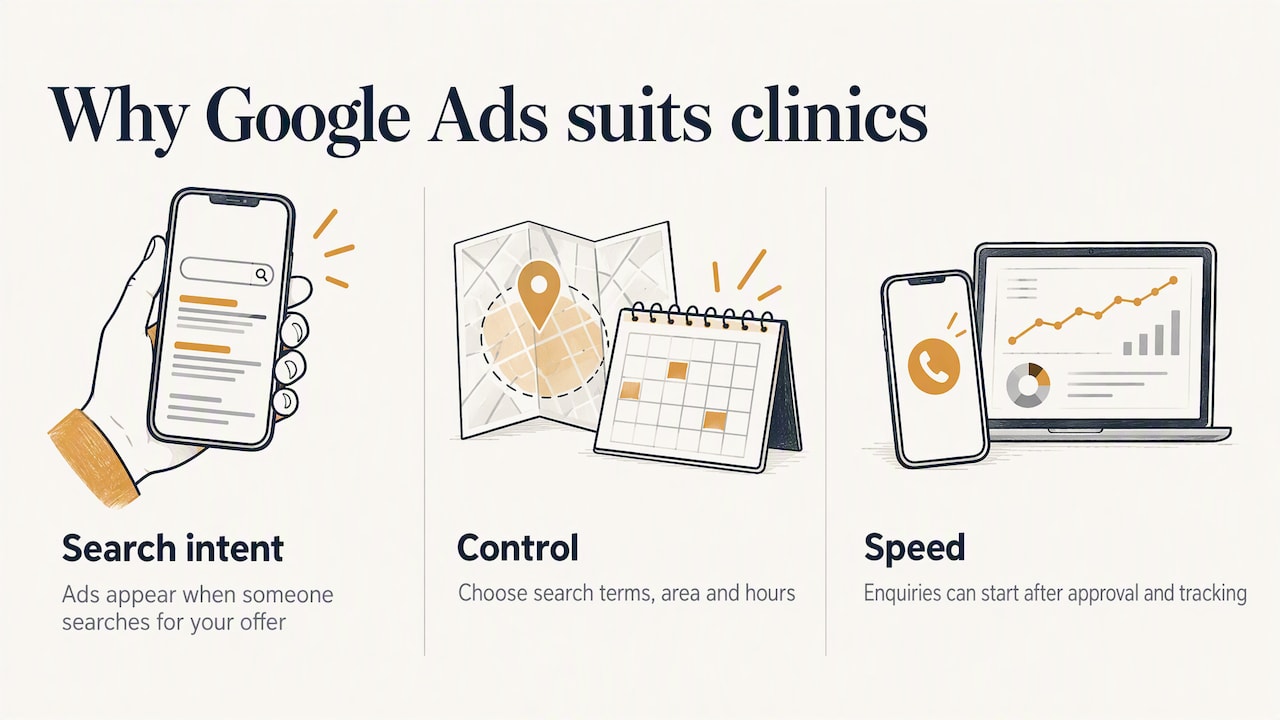
Most clinics win patients in two moments: when someone has a pain or a need and searches for it, and when they compare two or three options on the map. Google Ads sits on the first moment. You choose the search terms, the area and the hours, and your ad appears only when someone looks for what you offer.
That is a different logic from social media, where you interrupt someone who was not thinking about a dentist. With search ads, the intent is already there. Your job is to be present, relevant and easy to book.
There is a second reason it matters in Spain. Many clinics rely on directories and booking platforms that take a cut or put competitors beside you. Paid search lets you send patients to your own site and your own phone line, so the relationship starts with you.
Ads are also fast. Local SEO builds over months. Ads can start producing enquiries once the campaign is approved and tracking is live, which is why we use them as a bridge while organic work takes hold. If you want the organic side explained, read our guide to local SEO for clinics.
Rules to check before you advertise healthcare in Spain
Health is one of the most regulated advertising categories. Settle this before you spend anything.
Spanish law on healthcare advertising
Real Decreto 1907/1996 says advertising for healthcare centres must match the centre’s health authorisation, and that other health-related advertising needs prior express authorisation from the health authority. For products or methods with a purported health purpose, Article 4 prohibits promising certain relief or cure, using testimonials to induce consumption, and suggesting the product replaces a consultation or intervention by a healthcare professional.
In practice, for your ad copy this means:
- Describe the services your clinic is authorised to provide, and nothing beyond them.
- Do not promise a cure or guaranteed results.
- Do not use patient testimonials as a hook to push a treatment.
- Do not suggest that your treatment replaces seeing a doctor.
If you are unsure whether a specific treatment or claim is covered, ask your regional health authority or your legal adviser before launch.
Google’s own healthcare requirements
Google applies its own policies on top of the law. For some healthcare-related advertising, you need to apply for permission first, and Google Ads Help lists Spain among the countries where an advertiser may hold a licence when applying. Read the current policy in your account before you build the campaign, because disapproved ads cost you time at the exact moment you want to start.
Patient data and consent
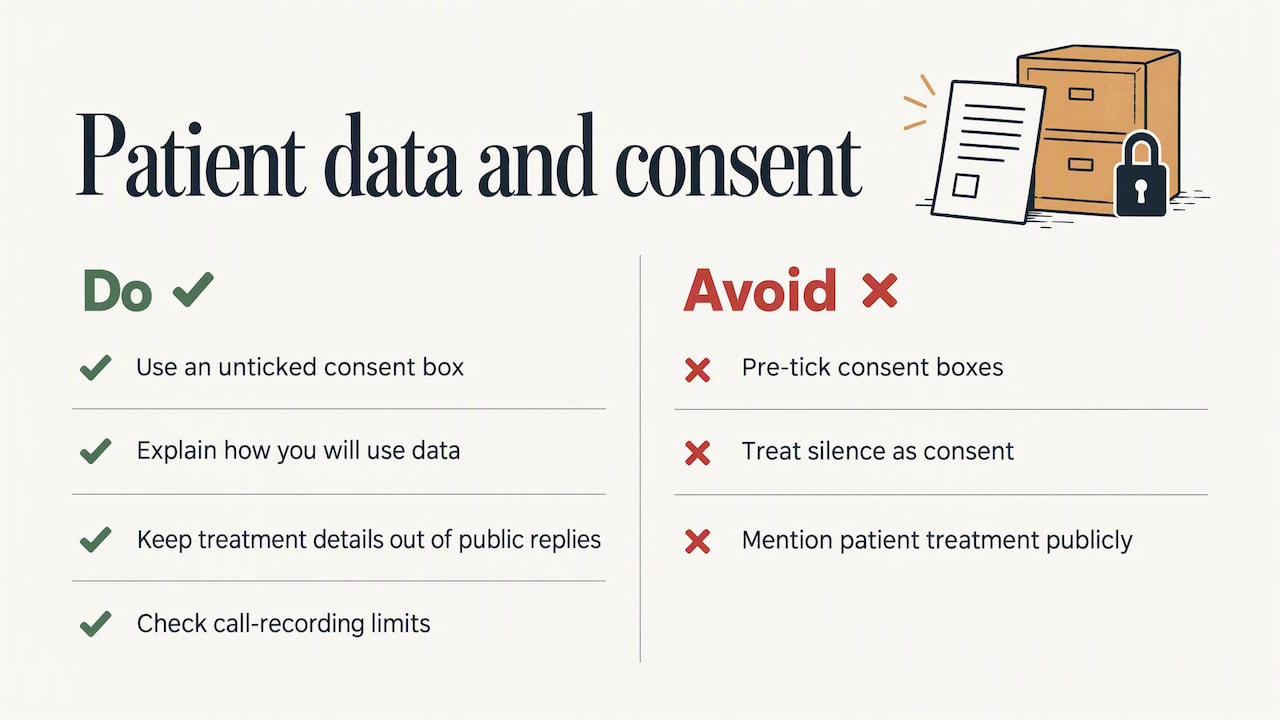
As soon as a form, a call or a chat collects personal details, GDPR applies. The Spanish data-protection authority explains that consent must be unequivocal, freely given and informed, given by a statement or clear affirmative action. Pre-ticked boxes and silence do not count. So your enquiry form needs an unticked consent box and a plain explanation of what you will do with the data.
Health information needs particular care in public too. In a decision about a reply on Google Maps, the AEPD treated the publication of a patient’s medicine and dosage as health-data processing and found it unnecessary. The lesson carries over to ads and review replies: never mention a patient’s treatment or details in public.
One technical detail: for healthcare businesses, call recording stays off unless manually enabled, and is available only for US or Canadian numbers. Spanish clinics should plan call tracking with that limit in mind.
Building the campaign: goals, keywords and location
Start with one goal: an appointment request
Pick the action that matters: a phone call, a WhatsApp message or a completed booking form. Everything else (impressions, clicks) is a means. Decide this first, because it determines your campaign type, your landing page and what you measure.
For most clinics, a Search campaign is the right base. People search for a treatment, you answer. Add other formats only once search is producing a steady, measurable flow.
Keywords: treatment plus place
The most useful terms combine what you treat with where you are. Doctoralia’s guidance for doctors recommends location-specific medical keywords, local targeting and negative keywords, with the example of a Barcelona clinic targeting “ginecólogo Barcelona” rather than paying for users far away who are unlikely to attend.
A practical structure:
| Keyword group | Example search | What the person wants |
|---|---|---|
| Treatment + city | “ortodoncia Málaga” | Compare clinics and book |
| Specialist + district | “fisioterapeuta Eixample” | A nearby appointment |
| Urgent need | “dentista urgencias Madrid” | Immediate availability |
| Problem-led | “dolor de espalda fisioterapia” | Find someone who treats it |
Group keywords by treatment, one ad group each. An ad for implants should lead to an implants page, not a general homepage.
Negative keywords protect the budget
Negative keywords stop your ads showing for searches that will never become patients. Typical ones for a clinic include job searches (“empleo”, “trabajo”), training (“curso”, “máster”), free-service searches (“gratis”) and treatments you do not offer. Review the search terms report every week at the start and add exclusions as you find them.
Our keyword research guide explains how to find the terms patients actually use, which also feeds your ads.
Geographic targeting
Target the area your patients genuinely travel from: your city, or the districts around the clinic. Be precise. A dental clinic in Alicante does not need to show ads across the whole province if most patients come from the city and nearby towns. Tight targeting also keeps your ads relevant, which helps efficiency.
Schedule ads for the hours when you can answer. An enquiry that goes unanswered until the next morning is often a patient lost to the clinic that picked up.
Writing ads that are compliant and clear
A good clinic ad is specific, calm and honest. It says what you treat, where, and how to act.
- Headline: treatment and place (“Ortodoncia en Málaga”).
- Description: what the first visit involves, languages spoken, availability.
- Extensions: location, call button, and links to treatment pages.
Avoid superlatives you cannot back up, promises of results and anything that implies a guaranteed outcome. The rules above on cures and testimonials apply to the ad as much as to the page.
If you serve international patients, which is common on the Costa del Sol, the Balearics and the Canary Islands, write ads and pages in the languages they search in. A visitor looking for an English-speaking GP will not click an ad written only in Spanish.
Landing pages that turn clicks into enquiries
The ad earns the click. The page earns the appointment. A landing page for a clinic should have:
- A headline that matches the search. If the person searched “blanqueamiento dental Valencia”, the page says exactly that.
- The treatment explained plainly: who it is for, what happens, how long it takes.
- Practical details: address, map, opening hours, phone, parking or transport.
- One obvious action: call, WhatsApp or book, visible without scrolling on a phone.
- Trust signals you can support: professional registration, your team, real reviews from your Google profile.
- A compliant form: short, with an unticked consent box and a link to your privacy policy.
Most clinic searches happen on mobile, so test the page on a phone first. Slow pages and hidden buttons waste the budget you spent to get the click. If your site is the weak link, our web design subscription is built to fix exactly that, from €99 per month.
Your Google Business Profile also shapes the decision, because patients compare your reviews and photos before they click anything. See why Google Business Profile matters for clinics and how to manage reviews well.
Budget: how to decide what to spend
We will not quote a single figure for “the right budget”, because it depends on things that differ by clinic. What drives cost:
- Competition for your treatment and city. High-value treatments in big cities attract more advertisers, so a click costs more.
- Your radius. A wider area means more searches, and more spend to cover them.
- Quality of ads and landing page. Relevant ads that match the page are generally more efficient.
- Your conversion rate. If more visitors enquire, each patient costs less to acquire.
The sensible way to set a budget runs backwards from the patient. Work out what a new patient is worth to you, how many enquiries become appointments, and what you can pay for each one. That gives you a target cost per appointment, and the budget follows.
Start with a focused campaign on your two or three most valuable treatments rather than spreading a small budget over everything. Scale what produces appointments once you have a few weeks of real data.
Metrics that show whether it works
Clicks are easy to count and easy to be misled by. Track the chain from search to chair:
| Metric | What it tells you |
|---|---|
| Enquiries (calls, forms, WhatsApp) | Whether the ad and page persuade |
| Cost per enquiry | How efficiently you generate leads |
| Booked appointments | Whether enquiries are the right kind |
| Attended appointments | Real patients, not just bookings |
| Cost per new patient | The number that decides the budget |
| Search terms report | Which searches bring patients and which waste money |
The gap most clinics miss is between enquiry and appointment. Ask reception to note where each new patient came from, and record how many calls were answered. A campaign can look weak when the real problem is a missed call.
Set up conversion tracking for calls and forms before you launch, so the data is there from day one. Without it you are guessing.
Common mistakes that waste a clinic’s budget
- Sending every ad to the homepage. Patients want the page for their treatment.
- Broad keywords with no exclusions. Generic terms attract job seekers and students.
- Targeting too wide an area. You pay for clicks from people who will not travel.
- No tracking. If you cannot see which clicks became appointments, you cannot improve.
- Slow answers. Unanswered calls and late replies cancel the value of the click.
- Ads outside the rules. Disapproved ads, or claims that break healthcare advertising law, create delays and risk.
- Setting and forgetting. Review search terms, ads and budgets regularly.
None of these is complicated. They are the difference between a campaign that is managed and one that is merely switched on.
How ads and local SEO fit together
Ads buy visibility today. Local SEO builds visibility that stays. A clinic that appears in the paid result, in the map pack and in organic results is much more likely to be the one the patient picks. Our guide on why ranking on Google Maps attracts patients covers the map side, and our 7 marketing strategies for clinics shows where ads sit in the wider plan.
Our perspective
We see the same pattern in clinics that come to us: the owner can see competitors in the map and the ads above it, and their own clinic is missing. The instinct is to switch on ads and hope.
Our view is that Google Ads works best for a clinic as one part of a system. The ad brings the click, the landing page converts it, the Google Business Profile and reviews reassure the patient, and the website’s SEO means you rely less on paid clicks over time. When these pieces are connected, the budget goes further.
We do not promise positions. We promise work you can check: what was set up, what was spent, which enquiries came in and what we changed next, reported every month with real data.
That is why we offer Turbo Google Ads as a bridge while organic SEO starts to take hold: patients can start finding you sooner, and the longer-term work builds in parallel.
YellowRock
Get your clinic seen while SEO builds
If you want ads running while your organic visibility grows, our Turbo Google Ads service is designed as that bridge, and it sits alongside our local SEO plans and web design. You can see everything we offer on our services page.
We offer a free visibility analysis of your clinic on Google, with no cost and no commitment, by WhatsApp. We will show you where you appear today, where your competitors appear, and where ads and local SEO can make the most difference.
FAQ
Are Google Ads worth it for a small clinic?
They can be, when the campaign targets specific treatments in your area and you track appointments, not clicks. A small, focused campaign on your most valuable treatments is easier to manage and measure than a broad one. Work out what a new patient is worth to you first, then set the budget from that.
Can clinics advertise any treatment on Google Ads?
Not without checking. Spanish law ties healthcare advertising to the centre’s authorisation and restricts claims such as promised cures, and Google has its own healthcare requirements, including an application process for some advertising. Check both before publishing, and ask your health authority if a specific treatment is unclear.
Should I use Google Ads or local SEO?
They do different jobs. Ads give you visibility quickly for chosen searches, while local SEO and your Google Business Profile build visibility that lasts. Most clinics benefit from combining them, with ads covering the early months.
What should I track to know if my campaign is working?
Track enquiries, booked appointments, attended appointments and cost per new patient, plus the search terms report. These show whether the campaign brings real patients. Clicks and impressions alone do not.
Sources
- Real Decreto 1907/1996, de 2 de agosto (BOE)
- Apply for healthcare-related advertising, Google Ads Help
- AEPD: how GDPR consent must be requested
- AEPD decision EXP202303482
- About AI-qualified call conversions, Google Ads Help
- Google Ads para médicos, Doctoralia