Restaurant SEO services get your restaurant in front of hungry people searching nearby, on Google Search and Google Maps, at the moment they pick where to eat. A good service works on four things every month: your Google Business Profile, your website, your reviews and your local mentions across the web. It reports what changed and promises no ranking positions, because nobody controls those. This guide explains what each piece involves, why a restaurant sometimes vanishes from the map, how to measure progress and how to pick a provider.
Key Takeaways
- Local results rest on three factors Google names itself: relevance, distance and prominence. Restaurant SEO works on the two you can influence, relevance and prominence.
- The Google Business Profile does the heaviest lifting for map visibility. The website, reviews and consistent listings support it.
- A restaurant that is missing from Google Maps usually has a verification, accuracy or eligibility problem, and most of these can be checked in an afternoon.
- Judge a provider by verifiable monthly work and clear reporting, not by guaranteed positions.
- If your neighborhood speaks English and Spanish, separate content in each language reaches diners a single-language site misses.
Table of Contents
- What restaurant SEO services actually include
- How Google decides which restaurants appear
- Google Business Profile: the first thing to get right
- Why your restaurant is not showing on Google Maps
- Your website: what it needs to say to Google and diners
- Reviews and local mentions
- The bilingual advantage in U.S. restaurant markets
- Perspective
- How to measure whether it is working
- How to choose a restaurant SEO provider
- Working with us
- FAQ
- Sources
What restaurant SEO services actually include
The label covers a lot, so it helps to split it into the jobs a provider should be doing. Semrush lists the typical tasks as adding relevant keywords to the site, setting up a Google Business Profile, encouraging reviews, building local citations and earning relevant backlinks. DoorDash’s merchant guide groups them into three areas: local SEO (profile, maps, directories), on-page SEO (content, structure, speed) and authority (mentions and backlinks).
In practice, a full service breaks down like this:
| Work area | What it covers for a restaurant | Why diners notice |
|---|---|---|
| Google Business Profile | Categories, hours and special hours, menu link, photos, attributes, posts, Q&A | It is the card people see on Maps and in the local pack |
| Website SEO | Location and menu pages, page speed on phones, structured content, reservation and order links | It tells Google what you serve and where you are |
| Reviews | A steady process to ask guests for feedback, plus replies | Stars and recent comments shape the final choice |
| Citations and mentions | Consistent name, address and phone across directories, local press, backlinks | It confirms to Google that you are real and well known nearby |
| Reporting | Profile insights, rankings by location, calls, direction requests, bookings | It shows whether the work pays off |
Notice what is not on the list: a promised spot at number one. Local results change with the searcher’s location, so no honest provider can guarantee one.
How Google decides which restaurants appear
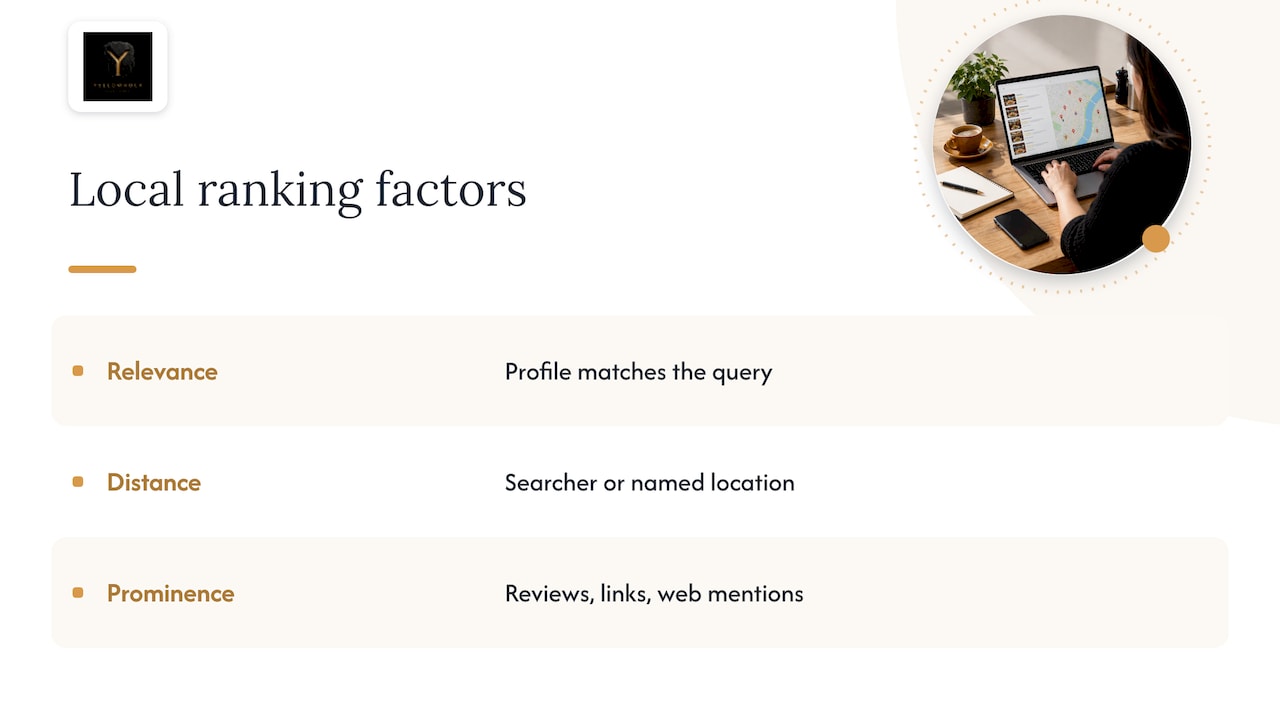
Google states that local results are mainly based on relevance, distance and prominence. Relevance is how well your profile matches what someone typed. Distance is how far you are from the searcher, or from the location they named. Prominence is how well known you are, which draws on reviews, links and mentions across the web.
You cannot move your building, so the work focuses on the other two. Google also says that businesses with complete and accurate information are more likely to appear in local results, and that incorrect details can stop a profile from showing for relevant searches. That single point explains most cases of a restaurant that seems invisible.
The visible prize is the map pack. OpenTable describes it as the group of listings Google shows beside a map above the regular results, which puts nearby restaurants in a prominent position. Sitting there puts your hours, photos and reviews in front of someone who is already deciding.
Google Business Profile: the first thing to get right
If you are only going to fix one asset this week, make it your profile. Google’s restaurant guidance says you can add or claim your profile, request ownership of one already on Maps, and verify your business. Once that is done, completeness matters. Google advises keeping the full address, regular and special hours, business category and extra details such as parking or Wi-Fi up to date.
A practical checklist for the profile:
- Use your real business name. No keywords added, no neighborhood tacked on.
- Choose the primary category carefully. “Italian restaurant” or “Cuban restaurant” tells Google more than a generic label. Add secondary categories only where they are true.
- Set special hours. Holidays, private events and kitchen closing times should all be entered before they happen.
- Add the menu link and keep the menu current. Google notes that customers may also see menu links and photos that other people uploaded, so your own should be the best ones available.
- Upload fresh photos. Dishes, the dining room, the entrance and the exterior help a first-time visitor recognize the place.
- Link reservation and ordering. Make the booking action one tap away.
- Post regularly. Specials, events and seasonal menus keep the profile active.
When you work with the same details everywhere, name, address and phone number should match on your website, directories and social profiles. OpenTable recommends keeping NAP consistent everywhere the restaurant appears online. A suite number written two ways looks minor to you but creates doubt in a system built to match records.
For a deeper walk-through of the Maps side, see our guide to ranking on Google Maps with a step-by-step process and our local SEO strategy for Google Maps.
Why your restaurant is not showing on Google Maps
Work through these causes in order, from most to least common. Most take minutes to check.
1. The profile is not verified. Google’s restaurant guide treats verification as a core setup step. An unverified profile is limited in what it can do. Open your profile manager and see whether a verification prompt is waiting.
2. Details are wrong or incomplete. Google says incorrect information can prevent a profile from showing for relevant searches. Check the address pin, phone number, category and hours against your actual door.
3. You changed something major. A new name, address or phone number is a typical moment for a profile to need attention. After any big change, log in, review the status and confirm nothing is flagged.
4. A duplicate or an old listing exists. If a previous tenant or an earlier owner created a listing at your address, the two can compete. Google lets you request ownership of a profile that already exists on Maps rather than starting another.
5. You are searching from the wrong place. Search Engine Land notes that Google heavily personalizes local results based on where the searcher stands. Checking from your own kitchen shows you a skewed picture. Ask friends in different neighborhoods, or use a location-based tracker.
6. Maps and Search disagree. The same guide advises tracking both Maps and Search because the same term can rank differently in each.
7. The competition is simply stronger nearby. If your profile is verified and accurate and you still sit low, prominence is the gap: fewer recent reviews, thinner website pages and fewer local mentions than the restaurants above you. That is the case where monthly work pays back.
If you cannot find the cause, bring in a specialist rather than repeatedly editing the profile, since frequent edits can make the picture harder to read.
Your website: what it needs to say to Google and diners
The profile gets the most direct credit for map ranking, but the site supports the claim. OpenTable points to a website that clearly tells Google and diners where you are and what you offer. For a restaurant, that means a few concrete pages:
- A home page with your cuisine, neighborhood, address, hours and a visible reservation or order button.
- A real menu in text, not only a PDF or an image, so search engines can read dish names.
- One page per location if you run more than one.
- Pages for private events, catering or brunch if you sell them, each with its own title and description.
- Fast loading on phones. Most nearby searches happen on a phone, often in transit.
Our complete guide to on-page SEO covers titles, headings and structure in more depth. If the site itself is the obstacle, we also build sites through our web design service.
Reviews and local mentions
Prominence is built largely from what other people say about you. Reviews are the most visible part: Google says the information customers see combines what you add with what others contribute. A steady flow of recent reviews, with thoughtful replies, tells both Google and the next diner that the place is active.
Two cautions. Never buy reviews or offer rewards for positive ones, and never ignore negative ones. We cover the reasoning in local SEO and Google reviews. Beyond reviews, mentions from local food writers, neighborhood sites, event pages and chamber of commerce listings add authority, and that is what backlink work is for.
The bilingual advantage in U.S. restaurant markets
In Miami, Orlando, Tampa, New York, New Jersey and Atlanta, many diners search in Spanish, in English, or switch between the two. A site with a translated copy of the English page rarely captures both groups, because people phrase searches differently in each language, “restaurante cubano cerca de mí” is not the same query as “Cuban restaurant near me”. This is why we work English and Spanish keywords, pages and content separately, so one restaurant can appear for both the English-speaking and the Hispanic customer in its area.
Perspective
We see the same pattern with independent restaurants: the food is excellent, but the Google Business Profile has old hours, the website has a PDF menu, and reviews stopped coming months ago. None of that needs a miracle. It needs consistent monthly work.
Our approach is to work the profile, the Maps presence, the website, the reviews and AI search visibility together, every month, in English and Spanish, with separate keywords and content for each language. We report what we did, so you can verify it. We do not promise ranking positions, and we deliberately keep a limited client portfolio so each restaurant gets real attention from a team that works in your time zone.
If you run a restaurant, bar or café that depends on people living and working nearby, local SEO is the channel closest to a reservation or a walk-in.
YellowRock
How to measure whether it is working
Set expectations around actions, not a single position. Google’s restaurant guidance says owners can track searches, menu clicks and completed bookings in their profile. Add calls, direction requests and website clicks, and compare month to month.
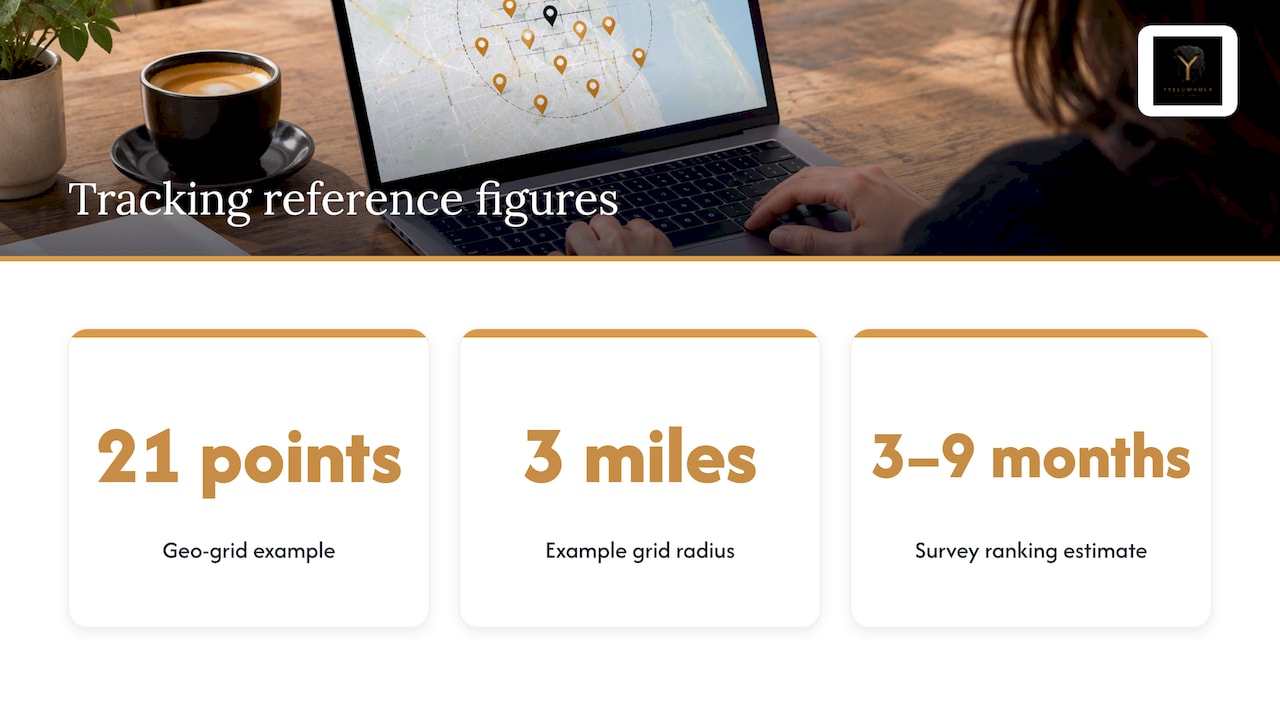
Because results differ by location, a grid view helps. Geo-grid rank trackers check rankings from multiple points around your business, for example a 21-point grid across a 3-mile radius, and show where you appear and where you vanish. Treat that as a map of your reach.
Profile metrics alone cannot prove revenue, so pair them with simple questions at the host stand or in the reservation form: how did you find us? Together those give a fair picture.
Timelines depend on your competition, your starting point and consistency. An old BrightLocal expert survey from 2014 found that most respondents expected significant local rankings in competitive markets within 3 to 9 months. Treat it as a rough indication of a multi-month effort, not as a promise.
How to choose a restaurant SEO provider
Use these criteria when you talk to agencies:
- Restaurant and local focus. Ask how they handle Maps, menus, hours changes and multiple locations.
- Defined monthly deliverables. Profile updates, content, backlinks and reviews should be listed, not vague.
- Transparent reporting. You should see what was done and what moved, in plain language.
- No guaranteed rankings. Local results are personalized, so a guarantee is a warning sign.
- Language fit. If your customers speak Spanish as well as English, the provider should work both separately.
- Time zone and access. A team that works your hours is easier to reach when a holiday menu changes.
- Contract clarity. Know the term, what is included, and what is an add-on.
Working with us
Every YellowRock engagement starts with a free SEO audit, so you see where your profile, site and reviews stand before choosing anything. Our three monthly plans, Starter, Growth and Authority, scale from core local SEO to bilingual work and visibility in AI search tools such as ChatGPT, Gemini and Perplexity. If you want quick traffic while organic work builds, Turbo Google Ads can be hired on its own.
For restaurants specifically, our article on digital marketing for restaurants shows how the pieces fit together. To start, request your free audit.
FAQ
How much do restaurant SEO services cost?
Prices vary by provider, number of locations and scope, and we do not publish ours. Ask each provider for a written list of monthly deliverables so you can compare like with like. Our free audit shows what your restaurant needs before you decide.
Is Google Business Profile enough on its own?
The profile gets the most direct credit for map visibility, but it works best alongside an accurate website, steady reviews and consistent listings. Google itself says that combined information from you and other sources helps customers decide. Think of the profile as the front door and the rest as the street leading to it.
Can anyone guarantee my restaurant will rank first on Google Maps?
No. Google personalizes local results by the searcher’s location, so positions differ from block to block. A trustworthy provider commits to specific monthly work and reporting instead.
What should I check first if my restaurant is missing from Maps?
Start with verification, then compare your address, category, phone number and hours with reality. Also check for duplicate or old listings at your address. If everything looks right, a specialist can audit the rest.
Sources
- Semrush: Restaurant SEO
- DoorDash for Merchants: SEO for restaurants
- OpenTable: Local SEO for restaurants
- Google: Tips to improve your local ranking
- Google: How Google sources and uses info in Business Profiles
- Google: Business Profile for your restaurant
- Search Engine Land: Local SEO audit guide
- GBP Rank Tracker: Local SEO rank tracking guide
- BrightLocal: How long does it take to rank in local search?