
Reply to most negative reviews, and reply fast, calmly and briefly. Thank the reviewer, name the specific problem, apologize for what was actually your fault, and move the conversation to a phone call or email. You are not writing for the angry reviewer. You are writing for the next customer who reads the review before choosing you. This guide covers when to reply and when to stay quiet, the structure of a good reply, examples you can adapt for a restaurant, clinic, contractor or hotel, and how to report reviews that break Google’s rules.
Key Takeaways
- A reply is a public statement to every future reader. Google’s own guidance is to be professional, polite, clear and helpful, and to keep it short.
- Not every review needs a reply. Research suggests a lone complaint among mostly positive reviews may not need one, while hostile pile-ons and troll reviews are better reported than argued with.
- Never put private customer details, discounts or promotional offers in a public reply. Invite the reviewer to call or email you instead.
- Google removes reviews only for policy violations, not because you disagree with them. Report fake or abusive ones; answer genuine ones.
- Replying is easier when reviews arrive steadily. A flow of fresh, honest reviews puts one bad one in proportion.
Table of Contents
- Why the reply matters more than the review
- Should you respond to every negative review?
- What a good reply contains
- Negative review response examples you can adapt
- How to handle the complaint offline
- When a review breaks the rules: reporting it
- A 10-minute routine for every new negative review
- Perspective: what we see in review management
- Getting more reviews so one bad one matters less
- Where YellowRock fits
- FAQ
- Sources
Why the reply matters more than the review
A negative review is one person’s account. Your reply is the only part of that page you control, and it is read by people deciding where to eat, which dentist to book, or which roofer to call.
The Better Business Bureau advises responding promptly and respectfully, acknowledging the concern and offering a direct way to reach you. Its reasoning is that prompt, respectful replies show prospective customers you take problems seriously. Search Engine Land’s guide to negative Google reviews makes the same point: a good reply shows accountability and commitment to resolution to everyone reading, even if the reviewer never returns.
This is a local search issue as well as a reputation one. When someone searches “dentist near me” or “best brunch in Tampa”, your star rating and your replies sit right next to your name. We cover how that visibility turns into calls and bookings in our guide to local SEO lead generation.
Should you respond to every negative review?
Mostly yes, but not always, and not the same way every time.
A Ghent University experiment with 973 respondents tested how the overall balance of reviews changes what kind of reply works. When only a minority of reviewers were dissatisfied, no response was necessary. With a mixed set of reviews, an apology and a promise to fix the problem worked best. When most reviews were negative, an apology, a promise and compensation were most effective.
For a local business with a solid average rating, that means:
- A genuine complaint from a real customer: reply. Even one lone voice among many happy ones is worth a short, kind answer, because it costs you two minutes and shows the standard you hold yourself to.
- A pattern of the same complaint (slow service, billing surprises, missed appointment windows): reply to each one, and fix the cause. Several similar reviews are a signal, not noise.
- A hostile, irrelevant or pile-on review: be careful. A 2025 dvm360 article reports a veterinary consultant’s advice not to engage with troll or pile-on reviews when a reply could amplify the conflict, and to report threatening or vulgar ones to the platform instead.
- A review that is plainly fake (not a customer, a competitor, a different business): report it, which we cover below. A short, neutral reply is optional.
One practical point: you can reply only after your profile is verified. Google Business Profile Help states that verification is required before you can respond to customer reviews. It also explains that your reply appears publicly under the review as a business reply, not under your personal name, and that the reviewer is notified and can edit their review afterward. That last detail is useful: a good reply sometimes leads to an updated rating.
What a good reply contains
Google’s own guidance on replying to reviews is clear and short. Be professional and polite, acknowledge the specific feedback, apologize when appropriate, be honest about mistakes and limitations, protect privacy, sign off personally, and keep the reply short because long replies lose readers. For a complex problem, invite the reviewer to contact you by phone or email. Do not include private information or promotional offers.
Turn that into a five-part structure:
- Greet and thank. Use the reviewer’s name if it is shown. “Thank you for telling us about this” is enough.
- Name the specific problem. “A 45-minute wait for a table you had reserved” shows you read it. “We’re sorry you had a bad experience” shows you did not.
- Own what is yours. Apologize for the actual failure. Skip excuses and denials, which the BBB specifically warns against. If part of the review is wrong, state the correct fact once, calmly, without contradicting the person.
- Offer a next step. Give a direct phone number or email and a named person.
- Sign off personally. First name and role: “Maria, owner.”
Then keep it to three to six sentences. If you find yourself explaining the history of the situation, you are writing for yourself, not for the reader.
Rules that keep you out of trouble
- No private details. Do not mention what someone ordered, what treatment they had, their address, their appointment time or their invoice. Google says never to share a reviewer’s private information.
- No public refunds or coupons. Offering a discount in the reply invites more complaints and breaks Google’s guidance on promotional offers. Resolve it privately.
- Do not argue. If you would not say it in front of the dining room or the waiting room, do not post it.
- Do not ask the reviewer to delete or change the review. Google’s policy prohibits incentives for posting, changing or removing reviews. Fix the problem and let them decide.
- Health and legal practices need extra care. Dental and medical practices are covered by U.S. health privacy rules, and law firms and accountants owe clients confidentiality. In those fields, do not even confirm that the reviewer was a patient or client in a public reply. Ask your compliance officer or attorney to approve a standard wording once, then reuse it.
Negative review response examples you can adapt
These are starting points. Change the details so each reply sounds like a person who read that review, and keep the length under about 80 words.
A service failure (restaurant, bar or café)
Hi Daniel, thank you for telling us about Saturday night. A long wait for food after your table was seated is not the standard we hold ourselves to, and I’m sorry we let you down. I would like to hear more and make it right. Please call me at [phone] or email [email]. Maria, owner
A vague complaint with no detail
Hi Chris, thank you for the feedback. This is not the experience we want anyone to have, and I’d like to understand what happened. Please reach me at [phone or email] so I can look into it properly. Jordan, general manager
A pricing complaint (home services, auto, salon)
Hi Alicia, thank you for sharing this. We understand that a final price can feel higher than expected, and we try to explain every estimate before work begins. I’d be glad to walk through how your job was quoted. Please call [phone] and ask for Tom. Tom, owner
A wait or scheduling complaint (clinic, vet, dental)
Thank you for your feedback. We know your time matters, and we’re sorry the wait was longer than it should have been. We are reviewing how we schedule appointments. If you’d like to talk with our practice manager, please call [phone]. Dr. Patel’s team
Notice that this reply does not say whether the writer was a patient. It speaks to the general standard, not to anyone’s visit.
A review you believe is wrong
Thank you for the review. We have looked for a record of the visit you describe and can’t match it, so we’d like to learn more. Please contact us at [email] so we can look into it. If this was meant for another business, we’re happy to help you find the right one.
If the review is not from a real customer at all, report it instead (see below).
A hotel or vacation rental review
Thank you for staying with us and for the honest feedback about the noise. We’re sorry it affected your rest. We’ve shared your comments with our team and we’re looking at how we can improve. If you’d like to talk it through, please email [email]. Elena, guest relations
A bilingual reply
If the review is in Spanish, answer in Spanish, and if it is in English, answer in English. A reply in the reviewer’s language shows the next reader from that community that you serve them too. Write the Spanish reply on its own, with natural wording, rather than running the English version through a translator.
Hola Carmen, gracias por contarnos lo que pasó. Lamentamos que la espera haya sido tan larga. Nos gustaría conocer más detalles y resolverlo: por favor llámenos al [teléfono] o escríbanos a [correo]. Luis, gerente
How to handle the complaint offline
The public reply opens the door; the real work happens in a private conversation.
- Call, do not just email. A voice solves things faster than three rounds of messages.
- Listen first. Let the person finish before you explain anything.
- Offer a fix you can deliver. A redo, a repair, a refund, a rescheduled visit. Do what you said you would do, and when you said you would.
- Close the loop. If they are satisfied, you may politely say they are welcome to update their review. Do not ask or pressure them to. The reviewer is notified of your reply and can edit the review.
- Record the cause. Note which shift, service line or step failed, so the complaint becomes a process fix.
When a review breaks the rules: reporting it
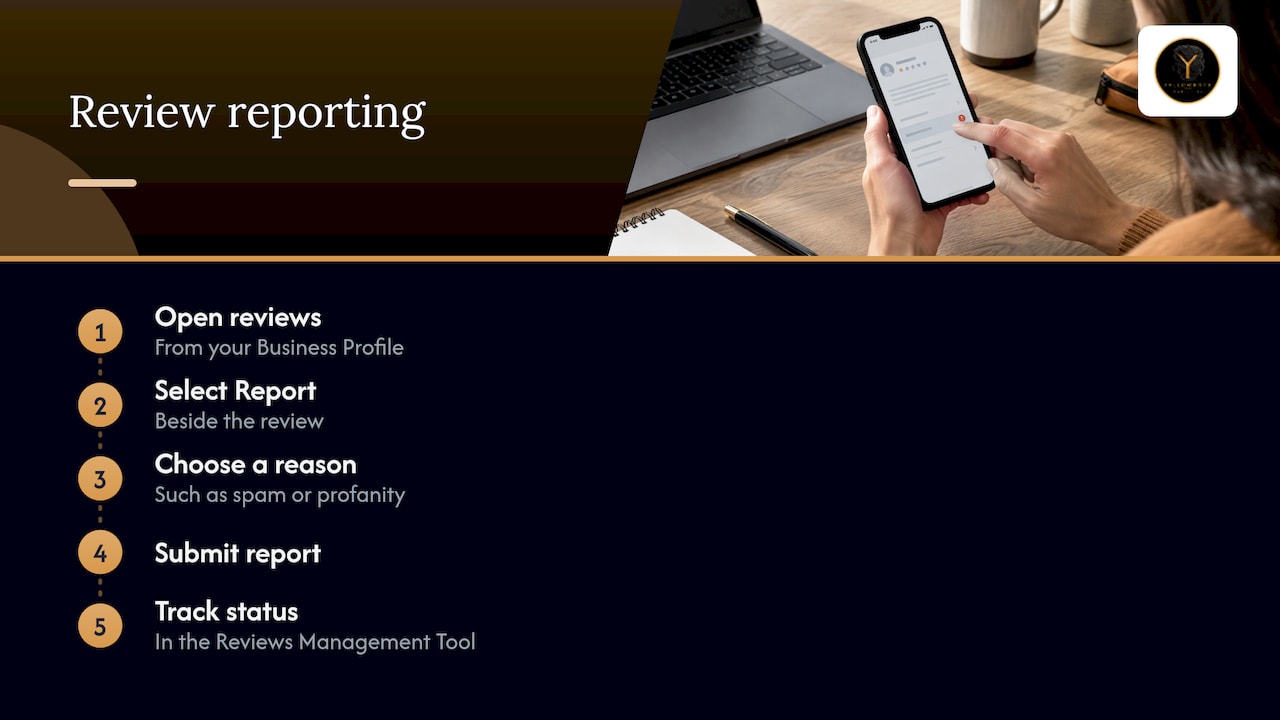
Some reviews are not feedback at all. Google’s process for reporting reviews is: from your Business Profile, open the reviews, select Report beside the review, choose a reason such as spam or profanity, and submit. You can track the status in the Reviews Management Tool.
The limit matters. Google removes reviews only for policy violations, not because a business disagrees with or dislikes them, and it does not mediate customer-business disputes. If no violation is found, you can make a one-time appeal.
What counts as a violation? Google’s Maps content policy prohibits reviews not based on a genuine experience, incentives for posting or removing reviews, and competitor reviews intended to undermine a business. The same policy prohibits businesses from discouraging negative reviews or soliciting only positive ones, while allowing requests for genuine reviews without incentives. If you are weighing shortcuts, read our piece on paying for Google reviews.
A simple rule: if the reviewer was a real customer with a real complaint, reply. If the review is spam, threats, profanity, a competitor or a non-customer, report it. If you are unsure, do both: a short, neutral reply and a report.
A 10-minute routine for every new negative review
- Wait ten minutes if you are angry. Draft the reply, then reread it as a stranger.
- Check the facts internally. Look up the booking, the ticket, the shift schedule.
- Decide: reply, report or both.
- Write three to six sentences using the five-part structure above.
- Post within a day or two. Fast replies read as attentive.
- Call the reviewer and fix it.
- Log the cause and share it with your team monthly.
If your team is busy, assign one named person to reviews and give them a short template library, like the ones above. Consistency of tone across replies is part of your brand.
Perspective: what we see in review management
We treat reviews as part of local search, not a separate chore. A restaurant, clinic or contractor is judged in the Google results by its rating, its recent reviews and the way it answers criticism, right next to its address and phone number.
That is why our local SEO work puts review systems alongside Google Business Profile optimization, Google Maps rankings and website SEO, all managed together every month. A reply template helps. A steady flow of genuine reviews helps more, because it puts any one complaint in proportion.
We also work in English and Spanish, with separate content for each language. For many of the businesses we serve, that includes replying to Spanish-speaking customers in their own language, so the reply reads as written by someone who belongs to the community.
We never promise ranking positions, and we do not recommend buying or trading for reviews. The goal is honest reviews from real customers and replies that show how you run your business.
YellowRock
Getting more reviews so one bad one matters less
The strongest defense against a negative review is a healthy review profile. Ask every satisfied customer, at the right moment, for an honest review, with no incentives and without steering them toward a rating. Our guide on how to get more Google reviews covers timing, wording and the channels that work for local businesses. Before you start, it helps to check that your profile is complete and accurate: our Google Business Profile audit checklist walks you through it.
Where YellowRock fits
If you would rather not manage reviews, profile updates and local rankings on top of running a restaurant, practice or crew, that is what our plans are for. Our Growth plan combines Google Business Profile optimization, Google Maps work, website SEO and review systems with separate English and Spanish content, so your business is found, and trusted, by both the English-speaking and the Hispanic customer in your area. Every engagement starts with a free SEO audit, so you see where your profile and reviews stand first.

See the Growth plan or our full list of services to find the fit for your business.
FAQ
How do I professionally respond to a negative Google review?
Thank the reviewer, name the specific problem, apologize for what you actually got wrong, and give a phone number or email to continue privately. Keep it short, polite and free of private details or offers, as Google recommends. Sign with your first name and role.
Should I respond to every negative review?
Reply to genuine complaints from real customers, ideally within a day or two. For hostile, abusive or fake reviews, reporting them is often wiser than arguing publicly. Research from Ghent University also suggests a single complaint among mostly positive reviews may not need a substantial recovery response.
Can I get a bad Google review removed?
Only if it violates Google’s policies, for example spam, profanity, fake engagement or a competitor’s attack. Disagreeing with a review is not a valid reason, and a one-time appeal is available if Google finds no violation. If it is a genuine review, a good reply is your best tool.
Should I reply in Spanish to a Spanish-language review?
Yes. Replying in the reviewer’s language shows every future reader from that community that you serve them. Write the reply on its own in natural Spanish rather than copying the English version word for word.
Sources
- Tips to get more reviews, Google Business Profile Help
- Manage customer reviews, Google Business Profile Help
- Report inappropriate reviews on your Business Profile, Google Business Profile Help
- Prohibited and restricted content, Maps user generated content policy
- BBB Business Tip: How to handle negative reviews
- How to Handle Negative Google Reviews & Protect Your Brand, Search Engine Land
- How review set balance moderates the effect of responses to online reviews, Ghent University
- Online reviews: To respond or not to respond, dvm360