

A local SEO audit service reviews every place a nearby customer can find you or fail to find you: your Google Business Profile, your map rankings, your reviews, your listings across the web, your website and, increasingly, AI answers. A useful one ends with a ranked list of fixes and a dated baseline you can measure against next month. At YellowRock Marketing, every engagement starts with a free SEO audit, built around that logic for businesses with a physical location.
This guide explains what a professional audit examines, how to read the results, what a good report contains and how to tell whether a service fits your industry and your customers.
Key Takeaways
- A local audit looks at far more than your website: Google Business Profile, Maps visibility, reviews, citations, links, on-page SEO and AI visibility all count.
- Local rankings change with the searcher’s location, so one rank number never describes your visibility. A map-based view across your service area does.
- A good audit records findings with a date so they can be compared month to month, and ties them to calls, direction requests, website clicks and bookings.
- Fixes should be ordered by what is costing you customers first: wrong profile data, thin reviews and inconsistent listings usually come before anything fancy.
- If your customers search in English and Spanish, the audit should look at both languages separately.
Table of Contents
- What a local SEO audit actually examines
- The checklist behind a thorough audit
- Why one ranking number is never the answer
- From findings to fixes: how to prioritize
- What a professional audit should deliver
- Is an audit service right for your business?
- Doing a first check yourself
- Start with a free audit
- FAQ
- Sources
What a local SEO audit actually examines
A local SEO audit is a structured review of the signals that decide whether Google shows your business to someone searching nearby. Search Engine Land’s local audit guide groups them into local and organic rankings, reputation, on-page optimization, engagement, citation health and growth, links, and AI visibility. Its worksheet tracks local pack and Maps visibility, listing accuracy, reviews, Google Business Profile features, and website and social health.
In plain terms, the audit answers five questions:
- Does Google know exactly what you are, where you are and when you are open?
- When someone nearby searches for what you sell, do you appear, and where?
- Do your reviews give a stranger enough reason to pick you?
- Is your information the same everywhere it appears online?
- Does your website back up everything your profile claims?
The local pack is the short list of three businesses with a map that Google shows above regular results for searches with local intent. Being in it is the goal for a restaurant, a dental practice or a plumber alike.
The checklist behind a thorough audit
You can use this list to understand what a service should cover, and to read any report you receive.
Google Business Profile
The profile is usually the first thing a nearby customer sees. The audit verifies that your business name matches your real-world name, that your address and phone are correct, that the website link lands on the right page, and that categories, hours (including holiday hours), photos and the map marker are right. Search Engine Land’s guide lists exactly these items, and notes photos should represent your current premises.
For a restaurant, that means a menu that matches the dining room and holiday hours that are actually posted. For a clinic, it means the right primary category and the right location for each office. For a contractor, it means the service area reflects where crews really work. We cover the profile in depth in our Google Business Profile audit checklist.
Maps and local pack visibility
This is where you find out whether people actually see you. The audit tracks where you appear in the local pack and on Maps for the searches that bring in customers, not just for your business name. Searching manually from different points around your area is the simplest way to see the gap, and a professional audit does it systematically.
Reviews
The audit looks at rating, count and sentiment, and at how recent and how answered your reviews are. A 4.8 with 40 reviews from three years ago reads differently from a 4.6 with fresh weekly reviews and owner replies. We have written about what works and what crosses the line with Google reviews.
Citations and listings
A citation is any online mention of your business name, address and phone number, on a directory, map app or industry site. HubSpot’s local audit guide recommends correcting stale listings after a business changes its name, location or phone number. Old addresses and duplicate listings are common after a move, a rebrand or a change of ownership, and they send customers to the wrong place.
Website and on-page SEO
Your site should repeat the same name, address and phone as your profile, have a clear page for each service and each location, and load well on a phone. The audit also inspects titles, headings, internal links and structured data, the code that tells search engines what a page is about. Search Engine Land’s worksheet includes organic rankings, on-page optimization, user behavior, link health and website health in the scope.
Links and competitors
Links from relevant local sites, such as a chamber of commerce, a local newspaper or a supplier, signal that you are a real business in a real place. A thorough audit also compares your visibility to the competitors who appear when you do not, and finds the keywords they win that you have not targeted.
AI search visibility
Customers now ask ChatGPT, Gemini, Perplexity and Google’s AI Mode for recommendations like “best dentist near me.” Search Engine Land’s audit framework now lists AI visibility as one of its audit areas. An audit that stops at the map pack misses a growing share of how people choose.
Why one ranking number is never the answer
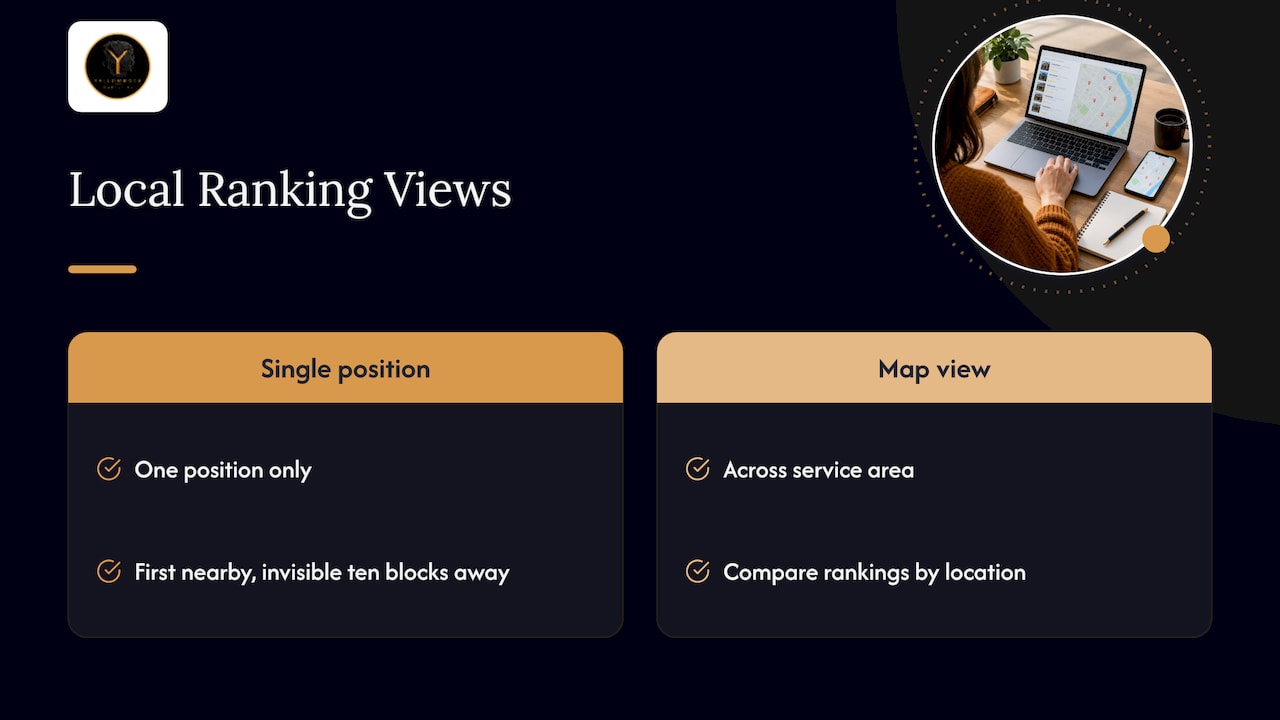
If an audit tells you “you rank #3,” ask where. Local rankings are personalized to the searcher’s location, and they can also shift depending on which businesses are open at the time. A café can be first for someone standing across the street and invisible to someone ten blocks away.
That is why a map-based view across your service area is more honest than a single position. For a multi-location business the point multiplies: each location has its own profile, its own reviews and its own neighborhood competitors. Our multi-location local SEO playbook shows how to handle that.
From findings to fixes: how to prioritize
An audit often surfaces dozens of issues. Not all deserve your attention first. A sensible order:
- Errors that send customers to the wrong place. Wrong phone, old address, wrong hours, duplicate listings. These cost you customers today.
- Profile completeness. Primary category, secondary categories, services, photos, attributes.
- Reviews. A steady flow of recent reviews, with replies.
- Website basics. Location and service pages, consistent contact details, mobile usability.
- Content and links. Ongoing work that builds authority over months.
- AI visibility. Clear, consistent, well-structured information that answer engines can read and quote.
A worked example: a dental practice moves across town. The audit finds the old address on four directories, a duplicate profile and a website footer with the old suite number. Fixing those three things comes before any new content, because patients are being sent to a closed office.
What a professional audit should deliver
The value of an audit is in what you can do with it. Look for these deliverables:
| Deliverable | Why it matters |
|---|---|
| Dated baseline of map and local pack visibility | Findings recorded so they can be compared over time show whether work is helping |
| Review snapshot (rating, count, sentiment) | Shows your reputation against nearby competitors |
| Listing and citation accuracy report | Identifies wrong, missing and duplicate listings |
| Website and on-page findings | Connects your site to your profile and your service area |
| Competitor and keyword gap view | Shows which searches you are losing and to whom |
| Prioritized action list | Turns findings into an order of work |
Then comes measurement. The same guide points to Google Business Profile clicks-to-call, clicks-to-site and bookings, along with website impressions, clicks, sessions and engagement. Rankings matter only if they lead to phone calls, direction requests, table bookings, appointments or booked jobs. A good report places both side by side.
A dated baseline matters because local results move. Without one, you cannot tell whether a change came from the work or from the season.
Is an audit service right for your business?
The audit pays off most when your revenue depends on customers in a specific area. Test any service against four points:
- Your location type. A single storefront, a service-area contractor and a ten-location group need different audits. Storefronts need a tight neighborhood view, contractors need service-area coverage, and groups need a per-location view.
- Your industry. A medical clinic is judged on trust and insurance details, a restaurant on menus, photos and hours, a real estate team on neighborhood pages and reputation, a hotel on direct-booking paths. The audit should speak your sector’s language.
- Your lead goal. Calls, bookings, walk-ins, appointment requests or seller leads. The report should name which metric it expects to move.
- Your customers’ language. In Miami, Orlando, Tampa, New York, New Jersey and Atlanta, many customers search in Spanish. If the audit only checks English keywords, it is blind to part of your market.
The bilingual gap
Spanish-language searchers use different words and different phrasing, and they do not match an English page translated word for word. At YellowRock we work English and Spanish keywords, pages and content separately, so a business shows up for both the English-speaking and the Hispanic customer nearby. An audit that measures both languages tells you which side of your market you are missing.
Doing a first check yourself
Before any audit, you can spot obvious problems in 20 minutes:
- Search your business name and the three services customers ask for most, on your phone, from your location and from a neighborhood a few miles away.
- Compare your Google profile against your website: name, address, phone, hours, categories.
- Read your last ten reviews and note whether you replied.
- Search your phone number and look for old or duplicate listings.
- Open the Performance section of your Google Business Profile and note calls, website clicks and direction requests as a starting baseline.
This tells you where the worst problems are. It cannot show your visibility across a whole service area or against every competitor, which is where a full audit earns its place.
How we look at a local audit
We think an audit is only worth doing if it leads to monthly work you can verify. Local search is not one channel: your Google Business Profile, Maps ranking, website, reviews and AI visibility all feed each other, so we work them together every month rather than one at a time.
We also treat language as part of the audit. For businesses in markets with large Spanish-speaking communities, we research English and Spanish keywords separately, because a single translated page rarely wins both audiences.
Our approach is built on transparent reporting and verifiable monthly work. We do not promise ranking positions, and we keep our client portfolio deliberately limited so each business gets real attention from a team that works in its time zone.
YellowRock
Start with a free audit
Every YellowRock engagement starts with a free SEO audit. From there, our three plans are built for different stages: Starter for local foundations, Growth for bilingual local SEO in English and Spanish, and Authority for AI search visibility. Web design and Turbo Google Ads can also be hired on their own. You can see everything we offer on our services page.

If you want to see where your restaurant, clinic, practice, studio, hotel or shop stands before you decide anything, start at yellowrockmarketing.com.
FAQ
What is included in a local SEO audit?
A full audit covers your Google Business Profile, Maps and local pack visibility, reviews, citations, website and on-page SEO, links, competitors and AI search visibility. The result should be a prioritized list of fixes, not just a score.
How is a local SEO audit different from a regular SEO audit?
A regular audit focuses on a website’s technical health and organic rankings. A local audit adds the profile, the map results, reviews and listings that decide whether nearby customers choose you, and it measures visibility by location rather than as one position.
How often should a local SEO audit be repeated?
The baseline comes first, then map visibility is reviewed regularly. Monthly checks across your service area are a common cadence, with a fuller review whenever you move, rebrand, add a location or change services.
What results should I expect from an audit?
The audit itself finds problems and ranks them; improvement comes from the work that follows. Track calls, direction requests, website clicks and bookings against your starting baseline to see whether changes are paying off.
Sources
- Local SEO Audit Guide: How to Improve Local Rankings, Search Engine Land
- Local SEO Audit: Everything You Need to Know, HubSpot
- Local Rank Tracking: How to Track Local SEO Rankings, Flento