

AI search visibility services get your business named when someone asks ChatGPT, Gemini, Perplexity or Google’s AI Mode where to eat, which dentist to book or who can fix a roof tonight. For a local business, that work rests on the same base as Google Maps and local SEO: a complete Google Business Profile, a website that states clearly what you do and where, consistent reviews, and content an AI system can read and quote. At YellowRock Marketing we run these pieces together every month, in English and in Spanish.
Key Takeaways
- AI search visibility means being mentioned, recommended or cited inside AI-written answers, not only ranking in a list of blue links.
- Google says the foundations that work in classic search carry over to AI Overviews and AI Mode, so local SEO is the starting point, not a separate project.
- A real service covers your Business Profile, website, reviews, regular content and measurement of how AI tools describe you, month after month.
- If your customers search in both English and Spanish, each language needs its own keywords and pages, because the AI answers are not the same in each.
- No honest provider promises a position inside an AI answer. Ask for monthly work you can verify and reporting you can read.
Table of Contents
- What AI search visibility actually means
- Why local businesses should care now
- What an AI search visibility service should include
- How the work differs by type of business
- Why language is part of AI visibility
- What to ask before you hire a provider
- A practical 90-day path
- Our perspective
- Where to start with YellowRock
- Common mistakes that cost local businesses AI mentions
- FAQ
- Sources
What AI search visibility actually means
A few years ago, a customer typed “best Cuban restaurant near me” and picked from a map and ten links. Today the same customer may ask a full question: “Which family dentist in Tampa takes evening appointments and speaks Spanish?” An AI tool answers in a paragraph, names two or three businesses, and often links to where it found the information.
AI search visibility is how often, and how favorably, your business shows up in those answers. The places where this happens include:
- Google AI Overviews: the summary Google places above results for many queries.
- Google AI Mode: a dedicated conversational search tab. Google describes it as a way to ask more complex questions and follow up with links to the web.
- ChatGPT, Gemini and Perplexity: assistants that customers use directly, often from a phone, with local questions.
You will see this work called AI search optimization, answer engine optimization (AEO) or generative engine optimization (GEO). They describe the same goal: make your business the easy, well-supported answer. If you want the longer version of what that involves, our page on generative engine optimization services lays it out.
Why local businesses should care now
The reader of this article is not a software company hunting for global brand mentions. You run a restaurant, a clinic, a brokerage, a gym, a hotel or a home services company. Your customer is within a few miles, ready to act, and increasingly asks a machine to shortlist options before ever opening a map.
Google’s own site-owner documentation says its AI features help people discover websites, and that being eligible takes no special markup: a page must be indexed and eligible to show a snippet in regular Search. In its guidance on succeeding in AI search, Google tells site owners to focus on unique, satisfying content for visitors and says the long-standing fundamentals carry across to the new experiences.
That is useful news for a local business. You do not need a different universe of tactics. You need the fundamentals done thoroughly, plus a layer that makes your information unambiguous to a machine reading it.
What an AI search visibility service should include
Tools that only report on AI mentions are a dashboard. A service does the work that changes what the dashboard shows. For a physical business, the work falls into six areas.
1. Google Business Profile, kept complete and current
Your profile is the most structured description of your business that exists: categories, services, hours, attributes, photos, posts, questions and answers. Google’s AI features and the assistants that draw on Google data work from facts like these. A profile with the wrong primary category, old hours or no services listed gives every AI system a weaker story to tell.
Our Google Business Profile audit checklist walks through twelve points worth checking, and fixing them is part of what we do monthly rather than once.
2. A website that answers the questions customers ask
AI answers are built from pages that state things plainly. That means a page per service, a page per location, and sentences that say what you do, where, for whom and at what typical scope. “We provide comprehensive solutions” gives an AI nothing to quote. “We replace residential water heaters in Orlando, same day in most cases, and we speak English and Spanish” does.
The basics of page structure still matter, which is why our on-page SEO guide belongs in the same conversation. If you are also planning a rebuild, web design is a service we offer on its own or alongside a plan.
3. Content published on a steady rhythm
One burst of blog posts does little. Search systems look for sites that keep covering their topics and are referenced elsewhere. Regular, useful content, backed by links from relevant sites, builds that pattern. We cover formats and cadence in our piece on turning content into the engine of your SEO, and weekly content with backlinks is part of how we work.
One caution from Google applies here. Its guidance on generative AI content warns that producing many pages without adding value for users can violate its spam policy on scaled content abuse. Volume for its own sake is a risk. Specific, checked, local content is the point.
4. Reviews, earned the right way
Reviews tell both people and machines what it is like to do business with you. The wording matters as much as the star rating: a review that mentions “Saturday brunch” or “emergency AC repair” or “our son’s first dental visit” ties your business to a real situation. A review system makes it easy for happy customers to say so, in their own words and their own language. We have written about why paying for opinions is a bad idea.
5. Consistent facts everywhere you appear
Name, address, phone, hours and services should match across your website, your profile and the directories that feed other platforms. When sources disagree, an AI has to guess, and it tends to leave out the business it cannot confirm.
6. Measurement of what AI tools say about you
The reporting side is simple in principle: a set of real customer questions in your category and city, checked on a regular schedule across the main AI tools, noting whether you are named, how you are described and which competitors appear beside you. Over months, that shows which fixes moved things. Treat any single result with care, since AI answers vary from one query and one day to the next.
How the work differs by type of business
The same six areas apply to every local business, but the questions customers ask differ.
| Business | Typical AI question | What to make easy to find |
|---|---|---|
| Restaurant or bar | “Best brunch with outdoor seating in Fort Lauderdale” | Menu pages, cuisine and dietary details, reservation link, photos, recent reviews |
| Dental or medical practice | “Pediatric dentist near me accepting new patients” | Services by name, insurance information, languages spoken, provider pages |
| Real estate brokerage | “Who sells condos in Brickell?” | Neighborhood pages, recent sales context, agent profiles, bilingual listings content |
| Hotel or rental manager | “Boutique hotel near the beach with parking” | Amenity detail, location context, direct booking page, reviews that mention stays |
| Med spa, salon, gym | “Pilates studio in Boston for beginners” | Class and treatment pages, first-visit information, pricing approach, instructor bios |
| Home services | “Emergency plumber in Jersey City” | Service area pages, response times you can honestly state, licensing details, reviews by job type |
| Law, accounting, insurance | “Immigration lawyer in Atlanta who speaks Spanish” | Practice area pages, attorney or advisor bios, languages, client questions answered |
If you are a brokerage, see how this fits with seller and buyer lead generation in our SEO for real estate agencies page.
Why language is part of AI visibility
A Spanish-speaking customer in Miami or Orlando asks questions in Spanish, and the AI replies in Spanish, drawing on Spanish-language pages and reviews. If your website exists only in English, or carries a machine-translated copy of each page, you may be invisible in that answer, even if you are the best option in your neighborhood.
Our approach is to treat English and Spanish as two separate searches. Each gets its own keywords, its own pages and its own content, written for how people in that language actually phrase the need. Spanish speakers do not search for “dentist” and “dentista” interchangeably in every context, and a Spanish phrase for an urgent care visit is not a word-for-word copy of the English one. Our guide to keyword research explains how those real opportunities are found.
What to ask before you hire a provider
The category is new and crowded, so the questions you ask matter. Use this list with any provider, and expect clear answers.
- What exactly will be done each month? You want named tasks: profile updates, pages written, content published, reviews handled, links built. “Optimization” alone is not an answer.
- Do you start from local SEO? For a business with a physical location, AI visibility built on a weak profile and a thin website will not hold.
- How do you handle two languages? Separate keywords and pages, or a translated copy?
- What do you report, and how often? Look for work completed, changes in Maps and search visibility, and how AI tools describe you for a defined list of questions.
- Do you promise positions? Nobody controls what an AI model says. A provider who guarantees a spot in ChatGPT is guessing or selling.
- Will I be one of a long list of clients? Capacity matters, because the work depends on knowing your business in detail.
- Who works on my account and when? A team in your time zone makes approvals and quick fixes simpler.
On the last three, here is how we answer. We do not promise ranking positions. We keep our client portfolio deliberately limited so every business gets real attention. Our team is based in the U.S. and works in our clients’ time zone, with verifiable monthly work and transparent reporting.
A practical 90-day path
You can judge any plan by whether it looks like this.
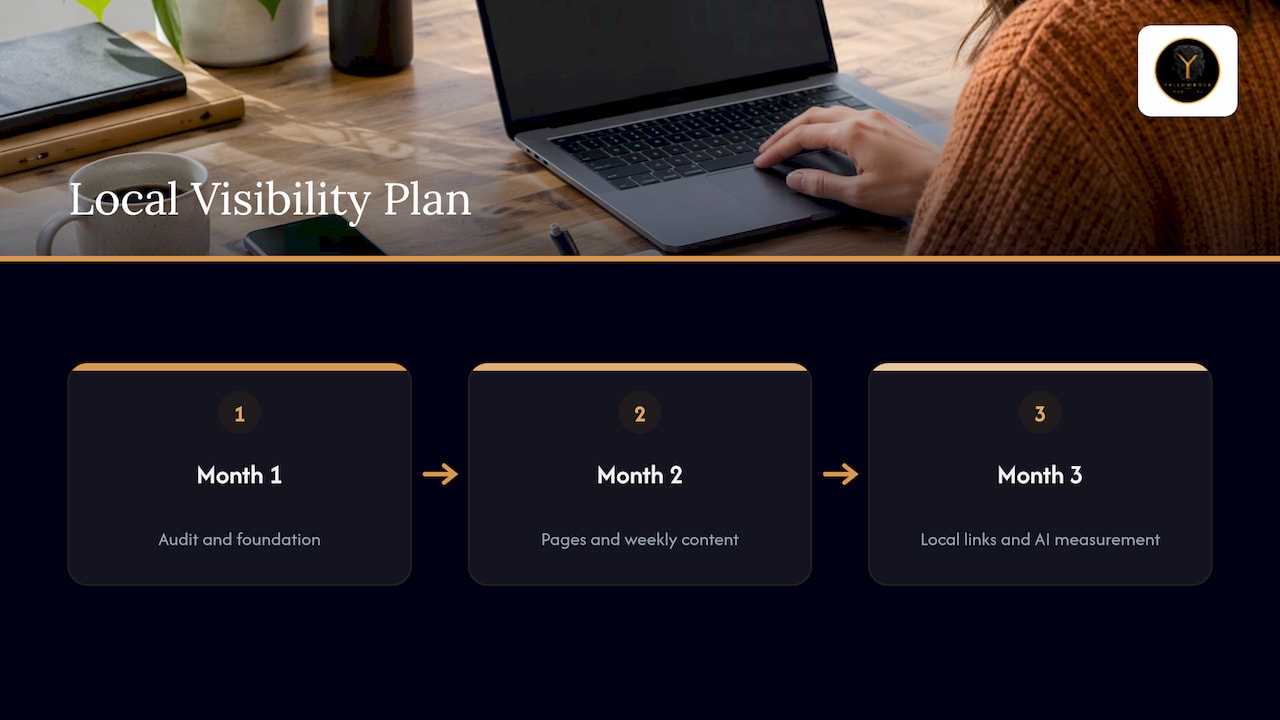
Month 1: audit and foundation. Review your Business Profile, website, reviews and listings. Fix categories, hours, services and inconsistencies. Identify the real questions customers ask in your category, in English and in Spanish.
Month 2: pages and content. Build or improve service and location pages. Start weekly content tied to those questions. Set up a review routine so new customers are invited to share their experience after a visit or job.
Month 3: authority and measurement. Add links from relevant local and industry sites. Check how AI tools answer your target questions and compare with where you started. Adjust the next quarter’s content to the gaps.
Then repeat. AI visibility behaves like local SEO: it compounds with consistent effort and fades when the effort stops.
Our perspective
We see AI search as local SEO with a sharper test. A machine summarizing a city’s options has no patience for a half-finished profile, a vague website or reviews that say nothing. The businesses it names are the ones whose facts are complete, consistent and easy to confirm.
That is why we do not sell AI visibility as a separate trick. Google Business Profile, Maps rankings, website SEO, weekly content with backlinks, reviews and AI search visibility are worked together every month, because each one feeds the others.
Language is the other half. Many of the customers our clients want to reach search in Spanish, and a translated page is not the same as a page built around Spanish keywords. We work English and Spanish separately, so a business is found by both the English-speaking and the Hispanic customer in its area.
We make no promises of ranking positions, and we limit the number of clients we take so each one gets real attention. What you get is work you can verify each month and reporting you can understand.
YellowRock
Where to start with YellowRock
Every engagement starts with a free SEO audit, so you see where your profile, website and reviews stand before anything else. From there, our three plans, Starter, Growth and Authority, scale the work. The Authority plan is built around AI search, and the Growth plan is our bilingual option. If you want to see everything in one place, our services page covers local SEO, Google Ads and web design.
If you need leads while the organic work builds, Turbo Google Ads can run on its own or next to a plan. To talk it through, start at yellowrockmarketing.com.
Common mistakes that cost local businesses AI mentions
- Treating it as a one-time project. Facts change: hours, staff, services, prices. An outdated profile teaches AI tools the wrong answer.
- Writing for machines instead of customers. Google’s guidance keeps returning to helpful content for visitors. Keyword-stuffed pages read poorly to people and to AI.
- Ignoring Spanish. If a large share of your area searches in Spanish, an English-only site leaves that demand to someone else.
- Chasing a screenshot. One good AI answer on one day proves little. Look at trends across a fixed set of questions over several months.
- Neglecting reviews. A profile with few recent reviews gives AI tools little proof that you are active and well regarded.
- Hiring for a guarantee. Anyone promising a fixed spot in an AI answer is promising something no one controls.
FAQ
Is AI search visibility different from local SEO?
They overlap heavily. Local SEO gets you into Maps and local results, and AI visibility adds the goal of being named and described accurately in AI-written answers. Google says the fundamentals behind classic search carry into its AI features, so we build on the same base and add measurement of how AI tools describe you.
How long does it take to see results?
It depends on your starting point, your market and how much needs fixing. Profile and website corrections can show up sooner, while content, links and reviews build over months. Anyone who names an exact date for appearing in AI answers is promising more than anyone can control.
Do I need separate work for ChatGPT, Gemini and Google AI Mode?
The foundation is shared: accurate listings, a clear website, strong reviews and steady content. Each tool draws on its sources differently, so we check how several of them answer the questions your customers ask and adjust from there.
Does my business need Spanish content for AI search?
If customers in your area search in Spanish, yes. They ask questions in Spanish and get answers drawn from Spanish-language pages. We build separate Spanish keywords, pages and content instead of translating the English site.
What does the free audit cover?
It is the starting point of every engagement with us: a look at where your SEO stands today, including your visibility in Google, Maps and AI search, so you can decide on a plan with real information.
Sources
- Get AI-powered responses with AI Mode in Google Search (Google Search Help)
- AI features and your website (Google Search Central)
- Top ways to ensure your content performs well in Google’s AI experiences on Search (Google Search Central Blog)
- Google Search’s guidance on using generative AI content on your website (Google Search Central)