
To rank higher on Google Maps, you need a complete, verified Business Profile with the right categories, a steady flow of genuine reviews, a website and local links that show your business is well known, and a way to measure results from more than one spot on the map. No single trick does it. Google bases local results mainly on relevance, distance and prominence, and the work is improving the two you control, relevance and prominence, month after month. If your customers search in English and Spanish, the same work has to happen in both languages, which is the way we run local SEO at YellowRock Marketing.
Key Takeaways
- Google ranks local businesses on relevance, distance and prominence. You cannot change distance, so your effort goes into relevance (a complete, accurate profile) and prominence (reviews, links, general visibility).
- Google says you cannot pay or ask for a better local ranking, but you can improve it by verifying your profile, keeping information accurate, answering reviews and adding photos and videos.
- Reviews are a marathon: a steady drip of real reviews beats a one-time push, and offering incentives for reviews is prohibited.
- A single rank check is misleading. Your position changes block by block, so measure from several points around your service area and compare over time.
- Bilingual markets need separate English and Spanish keywords, pages and content, not a translated copy.
Table of Contents
- How Google decides who shows up on the map
- Start with a profile Google can fully trust
- Reviews: the prominence signal you can build every week
- Links, citations and your website
- Ranking in English and Spanish
- How to tell whether it is working
- A realistic 90-day plan
- Where doing it yourself runs out
- Promo: local SEO built for your market
- Perspective
- FAQ
- Sources
How Google decides who shows up on the map
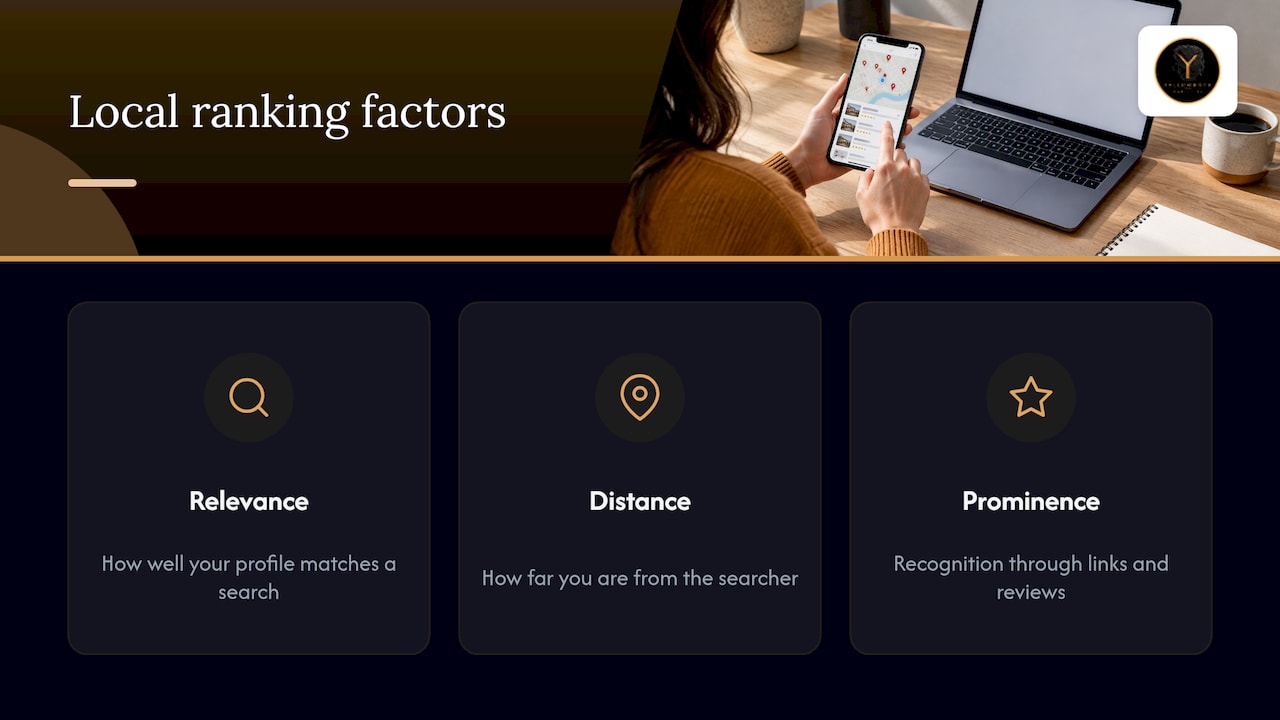
Google’s own help page lists three factors. Relevance is how well your profile matches what someone is searching for. Distance is how far you are from the searcher, or from the location Google associates with them. Prominence is how well known you are, based on things like how many websites link to you and how many reviews you have. Google also says more reviews and positive ratings can help your local ranking, and that it keeps the exact algorithm confidential.
Two consequences matter for an owner.
First, there is no permanent “number one.” Search Engine Land’s local pack guide notes that results are customized to the searcher’s location, so the realistic goal is to be visible to as many searchers in your market as possible. A dentist in Coral Gables and a diner in Philadelphia face the same rules, but each one’s ranking changes from street to street.
Second, geography does more than reorder results. A September 2026 Search Engine Land analysis of recovered Google data found that the area Google considers changes with the type of query and how dense the market is. In a crowded city, the pool of competing businesses near the searcher is small and tight. In a rural area, it stretches. The same analysis listed dozens of signals, including reviews, listing impressions, direction requests and website clicks, while stressing that the names were recovered and not their weights. The practical reading: Google watches how people interact with your listing, so a profile that earns calls, direction requests and clicks is working in your favor.
Start with a profile Google can fully trust
A verified Business Profile is free, and Google says it lets you keep hours, website, phone number and location accurate, post photos and videos, collect and respond to reviews. It is meant for storefront and service-area businesses, which covers nearly every reader of this guide. Google’s own tips for local ranking are the foundation:
- Verify the business. An unverified listing cannot compete.
- Keep information complete and accurate. That means full address, regular and special hours, the right category and attributes such as parking or Wi-Fi.
- Respond to reviews.
- Add photos and videos.
- Add in-store products, if you are an eligible retail business.
All five are listed on Google’s local ranking tips page.
Choose your categories carefully
Categories are the clearest relevance signal you control. Search Engine Land’s profile guide says Google allows up to 10 categories, and the primary category is the one displayed publicly and carries the strongest ranking impact. The primary category should describe the main thing customers hire or visit you for, as precisely as Google’s list allows: “Pediatric dentist” rather than “Dentist” if children are your core, “HVAC contractor” rather than “Contractor.” Add secondary categories for services that are real parts of your business, not for terms you wish to rank for.
Hours, attributes and the details people act on
For restaurants, bars and cafés, hours are where profiles most often fail: holiday hours not set, happy-hour and kitchen-close times missing, a phone number that no longer rings. Google’s 2026 profile playbook walks through setting regular, special and holiday hours. A hotel or B&B should confirm that its website link goes to the direct booking page. A clinic should confirm that the phone number reaches scheduling. These details decide whether a view turns into a customer, and customer actions are exactly what Google appears to watch.
Photos and videos
Google names photos and videos as an input to local ranking. Use real images: the entrance (so people find you), the interior, your team, your work. A med spa, a gym or a restaurant sells an experience, and a person comparing three nearby listings will pick the one that shows it.

Reviews: the prominence signal you can build every week
Reviews feed prominence directly. They also change who clicks. Between two listings at similar distance, the one with more reviews and a stronger rating usually wins the tap.
Search Engine Land’s guidance is to steadily earn and surpass your top competitors’ review counts while responding to all reviews. Its author describes review collection as a marathon, not a sprint: a steady drip of reviews week after week, produced by good customer experiences and a formal process for asking.
How to ask without breaking the rules
Google says you can ask customers to visit a review link or scan a QR code. It also says offering free or discounted goods or services in exchange for posting, changing or removing a review is prohibited. That rules out “free dessert for a five-star review” and “10% off if you leave a review.” A good routine is built on timing and ease:
- Restaurants and cafés: a QR code on the check presenter or receipt, plus a follow-up text for reservations.
- Dental, medical and vet practices: a text or email after the visit, sent by the front desk the same day.
- Home services: ask on the job site when the customer is happy, with the link in the invoice message.
- Real estate and professional services: ask at closing or when the matter ends.
We lay the process out in more detail in our guide on how to get more Google reviews, and explain why buying opinions backfires in our piece on paying for reviews.
Replying to every review
Google’s own reply guidance is simple: be professional, polite, short and conversational, personalize the reply, apologize when appropriate and respond promptly. In negative replies, protect the customer’s privacy: never confirm someone was a patient or client, or share details of their visit. Google also notes that a mix of positive and negative feedback often feels more trustworthy, so one three-star review answered well does not hurt you.
If you serve Spanish-speaking customers, reply in the language of the review. It tells the next reader that you serve people like them.
Links, citations and your website
Google ties prominence to how many websites link to your business. For a local business, good links are the ones a neighborhood would naturally give: the chamber of commerce, local press, a charity you sponsor, a supplier or partner page, a neighborhood guide. A law firm in Atlanta or a restaurant in Jersey City earns them by being visibly part of its community.
Citations, meaning your name, address and phone number on directories, help keep information consistent. Google says it compiles profile information from public web content such as your official website, licensed third-party data and user contributions. If your address or phone number differs across the web, that is the data Google may use to contradict your profile. Audit the major directories once, fix mismatches, and then keep them in sync whenever you move or change numbers.
What about your website? Search Engine Land reported in 2025 that adding keyword-rich content to your site does not create keyword relevance for your profile or lift map rankings, though it helps pages in regular search results. So the website and the profile play different roles. The profile wins the map. The website wins the organic listings below it, answers the questions people have after they tap, and supports the links and credibility behind prominence. A fast, mobile-friendly site with a page per service and per location is part of the same system. If your site is the weak point, our web design service is built for that.
If you run several locations, each needs its own profile, its own page and its own review flow. Our playbook for multi-location local SEO covers how to structure that.
Ranking in English and Spanish
In Miami-Dade, Orlando, Tampa, New York, New Jersey and Philadelphia, a large share of customers search in Spanish, in English, or both. Google matches relevance against the words people type, so a profile and website written only in English meet only part of the demand. The fix is not machine-translating pages. Spanish searchers use different phrases (“dentista de emergencia cerca de mí” is not a word-for-word version of the English query), and they should land on a page written for them.
This is the core of our approach: we work English and Spanish keywords, pages and content separately, so a business shows up for both the English-speaking and the Hispanic customer in its area. Reviews, service descriptions and profile questions in both languages reinforce the same message.
How to tell whether it is working
Here is the trap: you search your own business name from your office, see yourself at the top, and think you are doing fine. Local rankings do not work that way. A business can rank first next to its storefront and far lower two miles away, because Google customizes results to where the searcher is standing.
A useful measurement looks like this:
- Pick the three to five searches that bring you customers (for example “emergency vet,” “brunch near me,” “roof repair”).
- Check them from several points around your service area, not just from your door. Rank-tracking tools do this by running the same search from a grid of locations and saving the results.
- Repeat on a schedule, at least monthly, and compare to the previous scan. One day’s result is noise; the trend is the signal.
- Watch the actions inside your profile: calls, direction requests, website clicks and bookings. These are the results that pay the bills.
A reporting rhythm like this is why our work is verifiable month to month: you see what was done and what moved, and we do not promise specific ranking positions, because no one can honestly guarantee them.
A realistic 90-day plan
Weeks 1 to 2: fix the foundation. Verify the profile, set the primary category, add secondary categories, correct hours and attributes, upload at least a dozen real photos. Our 12-point profile audit checklist is a good way to go through this.
Weeks 3 to 6: build the review habit. Put a QR code or link in the customer journey, train staff on when to ask, and reply to every review, old ones included.
Weeks 6 to 12: widen your footprint. Clean up directory listings, earn a few local links, add service and location pages to your site, and write Spanish versions of the pages that matter if you serve Spanish-speaking customers.
Throughout: measure from several points and watch calls and direction requests.
Where doing it yourself runs out
Google’s profile is free and the basics are within any owner’s reach. The difficulty is consistency. Reviews need weekly attention, links need outreach, directories need upkeep, two languages double the content, and a restaurant manager or a dentist is already full. That is where an agency earns its fee, and it is the reason our work is organized as a monthly program rather than a one-time setup.
Promo: local SEO built for your market
We are a local SEO agency for independent businesses with a physical location. Our work covers Google Business Profile optimization, Google Maps rankings, website SEO, weekly content with backlinks, review systems and visibility in AI search such as ChatGPT, Gemini, Perplexity and Google AI Mode, all in English and Spanish.

There are three plans, Starter, Growth and Authority, and every engagement begins with a free SEO audit. Visit YellowRock Marketing to request yours. Our team is based in the U.S. and works in your time zone, and we keep a deliberately limited client portfolio so each business gets real attention.
Perspective
Most owners come to us after one of two experiences: a profile that was set up once and never touched, or a review push that stalled after a month. In both cases the problem is the same. Google Maps rewards a business that is accurate, active and well known, and those are habits, not tasks.
That is why we work the pieces together every month: the Business Profile, the reviews, the website, the local links and, increasingly, visibility in AI answers. A profile without reviews stalls. Reviews without a website that backs them up leave visibility on the table. And in markets like Miami, Tampa or New York, doing all of it in only one language leaves a large part of the community unserved.
So we treat English and Spanish as two separate searches with separate keywords, pages and content. We report the work every month so you can see it, and we do not promise ranking positions, because the map changes with every searcher’s location. What we can promise is steady, verifiable effort on the signals Google says it uses.
YellowRock
FAQ
Can I pay Google to rank higher on Maps?
No. Google states that you cannot request or pay for a better local ranking. What you can do is verify your profile, keep it complete and accurate, respond to reviews and add photos. If you want paid placement on top of that, Google Ads is a separate channel, and our Turbo Google Ads service covers it.
Why do I rank first near my shop but not across town?
Because distance is one of the three ranking factors, and Google customizes results to the searcher’s location. A business can be first next to its storefront and far lower a couple of miles away. This is why you should measure from several points around your service area, not from your own door.
How many reviews do I need?
There is no magic number. Search Engine Land’s advice is to steadily build toward and past the review counts of your strongest local competitors while responding to every review. Count the top three results for your main search, set your goal above them, and aim for a steady weekly pace rather than a burst.
How long does it take to move up?
Google publishes no timeline, and results depend on your market and competition. Profile fixes can be reflected within weeks, while reviews and links build prominence gradually. Track monthly trends rather than daily changes.
Does my website matter for Google Maps?
Yes, but in a supporting role. Google draws profile information from your official website and counts links to it as part of prominence. Search Engine Land reports that keyword-rich website text does not by itself raise your map rankings, so the profile, reviews and links carry the map work, while the website converts visitors and ranks in regular results.
Sources
- Tips to improve your local ranking on Google, Google Business Profile Help
- Get started with Google Business Profile
- Tips to get more reviews, Google Business Profile Help
- Understand how Google sources and uses info in Business Profiles
- Google Business Profile Best Practices Playbook 2026
- What Is the Google Local Pack? How to Rank in the 3-Pack, Search Engine Land
- How to set up and optimize your Google Business Profile, Search Engine Land
- Inside Google Maps: 72 ranking signals and the architecture behind local search, Search Engine Land
- Why website content won’t boost your Google Maps keyword rankings, Search Engine Land