
Local SEO services in Florida get a business with a physical location to show up in Google Maps, the local results and AI answers when a nearby customer is ready to buy. The work centers on your Google Business Profile, your website, your reviews and your consistency across the web. In Florida it also has to work in two languages. If you want a team that handles all of it every month, in English and Spanish, with separate keywords and pages per language, that is what we built YellowRock Marketing to do.
This guide explains what the service includes, what Google says decides who ranks, what changes in Florida, and how to judge any agency before you sign.
Key Takeaways
- Google says local results rest mainly on relevance, distance and prominence, and you cannot pay for a better local ranking. The work is earning those signals, month after month.
- A complete, accurate Google Business Profile, steady reviews and a website with real pages for each service and city are the core of the job.
- Florida is a bilingual market: about 31.4% of residents age 5 and older speak a language other than English at home, and most of them speak Spanish. English-only SEO leaves customers unreached.
- AI Overviews and chat assistants now answer many local questions, so visibility has to be tracked beyond the classic map pack.
- A good agency shows monthly work you can verify and never promises a ranking position.
Table of Contents
- What local SEO services in Florida actually include
- How Google decides who appears in Maps and local results
- The work that moves the needle for Florida businesses
- Why Florida is a bilingual SEO market
- AI search: what Florida businesses should track in 2026
- What an engagement should look like
- How to evaluate a Florida local SEO agency
- Which plan fits which business
- Start with a free audit
- Our perspective
- FAQ
- Sources
What local SEO services in Florida actually include
Local SEO is the set of tasks that make Google confident your business is the right answer for someone searching nearby. A search like “dentist near me” or “AC repair in Tampa” triggers a map pack, the block of three businesses with a map above the regular results. Search Engine Land’s guide notes these results are highly customized to the searcher’s location, so a customer on one side of town can see different businesses than a customer on the other side.
A full-service program usually covers these areas:
- Google Business Profile optimization. Your free listing on Google and Maps: categories, services, hours, photos, posts, questions and answers, and the link to your site.
- Website SEO. Pages that match what customers search, with a clear page per service and per city or neighborhood you serve.
- Content with backlinks. Regular content that earns mentions and links from other local sites.
- Review systems. A steady, honest process for asking happy customers for reviews and answering every one.
- Citations and listing consistency. Your name, address and phone number matching across directories.
- AI search visibility. Being named when someone asks ChatGPT, Gemini, Perplexity or Google AI Mode for a recommendation.
- Reporting. A monthly account of what was done and what moved.
Those are the same parts we work together every month: Google Business Profile, Google Maps, website SEO, weekly content with backlinks, reviews and AI search visibility.
How Google decides who appears in Maps and local results
Google’s own guidance is the best place to start. It says local results are based mainly on relevance, distance and prominence. Relevance is how well your profile matches the search. Distance is how far you are from the searcher, or from the location they named. Prominence is how well known you are, which draws on reviews, links and mentions across the web.
Google also states there is no way to request or pay for a better local ranking. What it advises is to verify your profile, keep your business information complete and accurate, and respond to reviews.
That has a practical meaning. You cannot control distance: a restaurant in Coral Gables will not outrank a closer one for a searcher standing next to it. You can control relevance and prominence, and that is where the monthly work goes.
Why your ranking looks different from your customer’s
Because local results depend on where the searcher is, checking your own ranking from your office tells you little. Owners are often surprised to find they rank first from their own parking lot and third a mile away. A report that shows rankings at several points around your service area is a more honest picture of reach than one screenshot.
The work that moves the needle for Florida businesses
Not every task is equal. For a business with a storefront, clinic, office or service area, this is the order we would put things in.
1. A complete, accurate Google Business Profile
Google’s guidelines for representing your business set the rules that matter here. You use a precise, accurate address or service area. You choose the fewest categories that describe your core business. You keep one profile per location. Virtual offices without a real operating location are not eligible.
These are the mistakes that get Florida profiles suspended or buried: a P.O. box as an address, a second profile for the same location, a business name stuffed with keywords, and ten categories where two would do. Fixing them is often the fastest win available.
2. Reviews, on a rhythm
Reviews feed prominence, and they also persuade the person deciding between three listings. Reply to every review, good or bad, in a calm and specific way. Ask at the moment a customer is happiest: after a finished repair, a good appointment, a meal that landed well.
Do not buy reviews. Google prohibits fake and incentivized reviews, and we wrote about why paying for opinions backfires. A review system built on real customers is slower to start and far safer to keep.
3. Website pages that match real searches
A one-page site with a phone number rarely competes. Local ranking improves when each service has its own page and each city or neighborhood you actually serve has real content, not a list of town names at the bottom of the home page. Our guides on on-page SEO and keyword research cover how those pages are built.
A Miami plumber and a Jacksonville plumber should not share a page. Neither should a Naples boutique hotel and a Panhandle B&B. Each market has its own search habits, neighborhoods and competitors.
4. Local links and mentions
Links from local newspapers, chambers of commerce, sponsorships and neighborhood partners tell Google your business is real and known. This is slow work that compounds. See our overview of local link building for neighborhood businesses.
5. Consistent listings
The same name, address and phone number everywhere. It is unglamorous, and it prevents the quiet damage of old addresses and duplicate listings confusing Google about where you are.
Why Florida is a bilingual SEO market
Florida is where English-only local SEO leaves the most money on the table. The Census Bureau’s QuickFacts puts the state’s Hispanic or Latino share at 28.7%. USAFacts, using American Community Survey data, reports that 31.4% of Floridians age 5 and older speak a language other than English at home, against 22.9% nationally, and that about 74.7% of those speakers speak Spanish.
In practice, a Spanish-speaking customer in Hialeah, Kissimmee or Sweetwater often searches in Spanish: “dentista cerca de mí”, “plomero de emergencia”, “clínica pediátrica en Orlando”. Google treats those as different queries from their English versions, with different results. Translating your English page word for word rarely matches how people actually type.
That is why our approach works English and Spanish keywords, pages and content separately. The Spanish page is researched on its own terms and written to rank on its own, so you appear for the English-speaking and the Hispanic customer in the same neighborhood. Our Growth plan is the one built around bilingual SEO.
AI search: what Florida businesses should track in 2026
The map pack is no longer the only place you can be found. Search Engine Land’s guide, citing a Whitespark study, reports that AI Overviews appeared for 68% of local searches and local packs for 39% of queries. The same guide reports AI Overviews showing for 92% of informational local queries but only 15% of simple local ones, where local packs still appear for more than 90%.
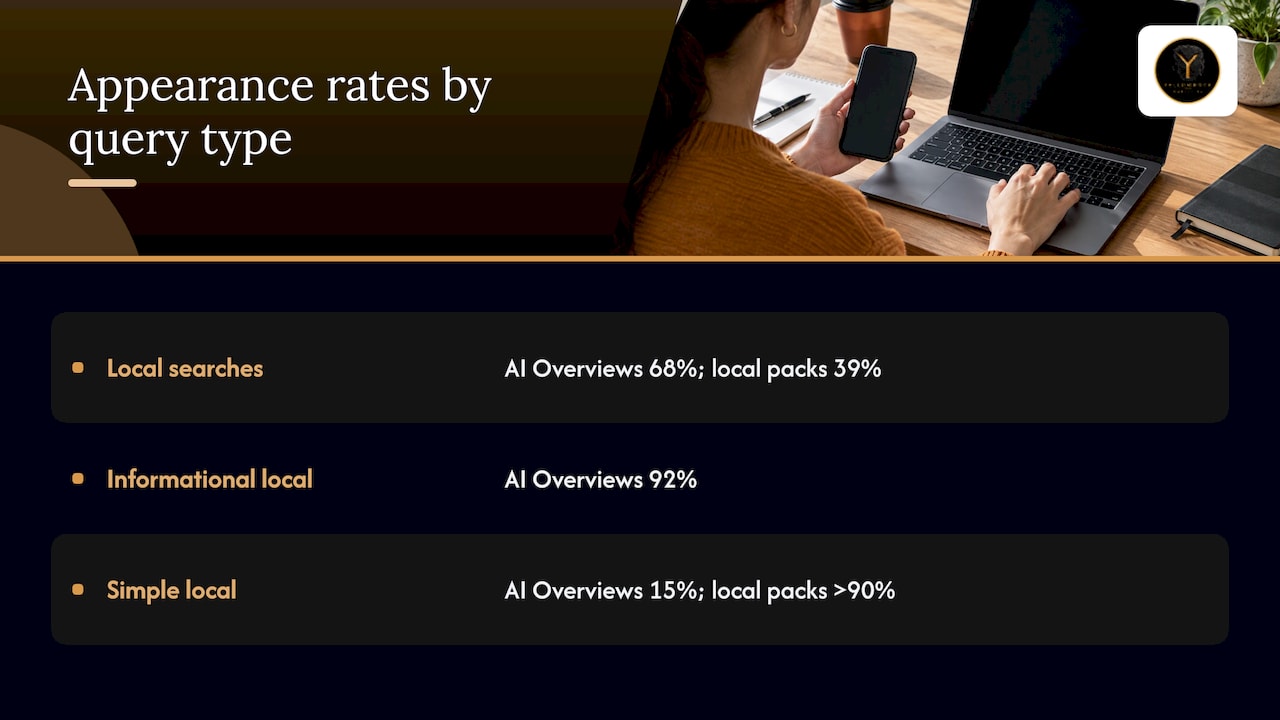
Read that as a split. A customer asking “best place for brunch in Fort Lauderdale with outdoor seating” may get an AI-written answer that names a few businesses. A customer typing “emergency vet” gets the map pack. You need to be present in both.
Search Engine Land recommends tracking visibility in AI environments such as ChatGPT, Google AI Mode and Perplexity alongside Search Console, Analytics and local rankings, and adding UTM codes to the links in your Google Business Profile so you can see which visits came from it. We cover how this works in our page on AI search visibility for local businesses, and the Authority plan is built around AI SEO.
The fundamentals feed both. An accurate profile, real reviews, clear pages and consistent mentions are what Google’s map results and AI answers both draw on.
What an engagement should look like
Whatever agency you consider, the process should be easy to describe. A sound local SEO engagement tends to run in this order.
- Audit. The agency reviews your profile, site, reviews, listings and competitors, and shows you what it found. Every engagement with us starts with a free SEO audit.
- Plan. Priorities are set by your business: which locations, services and languages, and which customers matter most.
- Fixes first. Profile errors, category problems, duplicate listings and thin pages usually come before new content.
- Monthly work. Content, links, review requests, profile updates and AI visibility work, done on a schedule.
- Reporting. You see what was done, what changed and what comes next, in plain language.
If you run more than one location, each needs its own profile and its own page, and the plan has to account for that. Our playbook for multiple locations walks through it.
How to evaluate a Florida local SEO agency
Most owners hire an agency once and live with the result for a year or more, so the questions are worth asking up front.
Ask what exactly is done each month. “SEO” is not a deliverable. A profile update, a published page, a set of links earned and a review-reply process are. You should be able to point to the work.
Be wary of ranking guarantees. Given what Google says about not being able to buy a local ranking, no one can promise position one. We make no promises of ranking positions. What we offer is verifiable monthly work and transparent reporting.
Check for real bilingual capability. If you serve Spanish-speaking customers, ask whether Spanish keywords and pages are researched separately or just translated.
Ask who you will talk to. A team in your time zone that answers during your business hours matters when something breaks. Our team is based in the U.S. and works in the client’s time zone, and we keep our client portfolio deliberately limited so each business gets real attention.
Look at fit with your industry. Restaurants, dental practices, clinics, hotels, med spas, gyms, veterinary clinics and home services all have different search patterns. We specialize in those industries, along with real estate, professional services and local shops.
Understand the price drivers. Cost depends on the number of locations, how competitive your market is, the size of your site and what services you need. Our plans do not carry a published price, so the free audit is where scope and pricing get discussed for your case.
Which plan fits which business
| Situation | Where to start |
|---|---|
| One location, a profile and site that need fixing and steady upkeep | Starter |
| You serve English- and Spanish-speaking customers and want to rank for both | Growth |
| You want to be named in AI answers as well as in Maps | Authority |
| Your site is dated or not built to convert visitors | Web Design |
| You want paid placement alongside organic work | Turbo Google Ads |
Web Design and Turbo Google Ads can also be hired on their own. Social media management is available as an add-on to a plan.
Start with a free audit
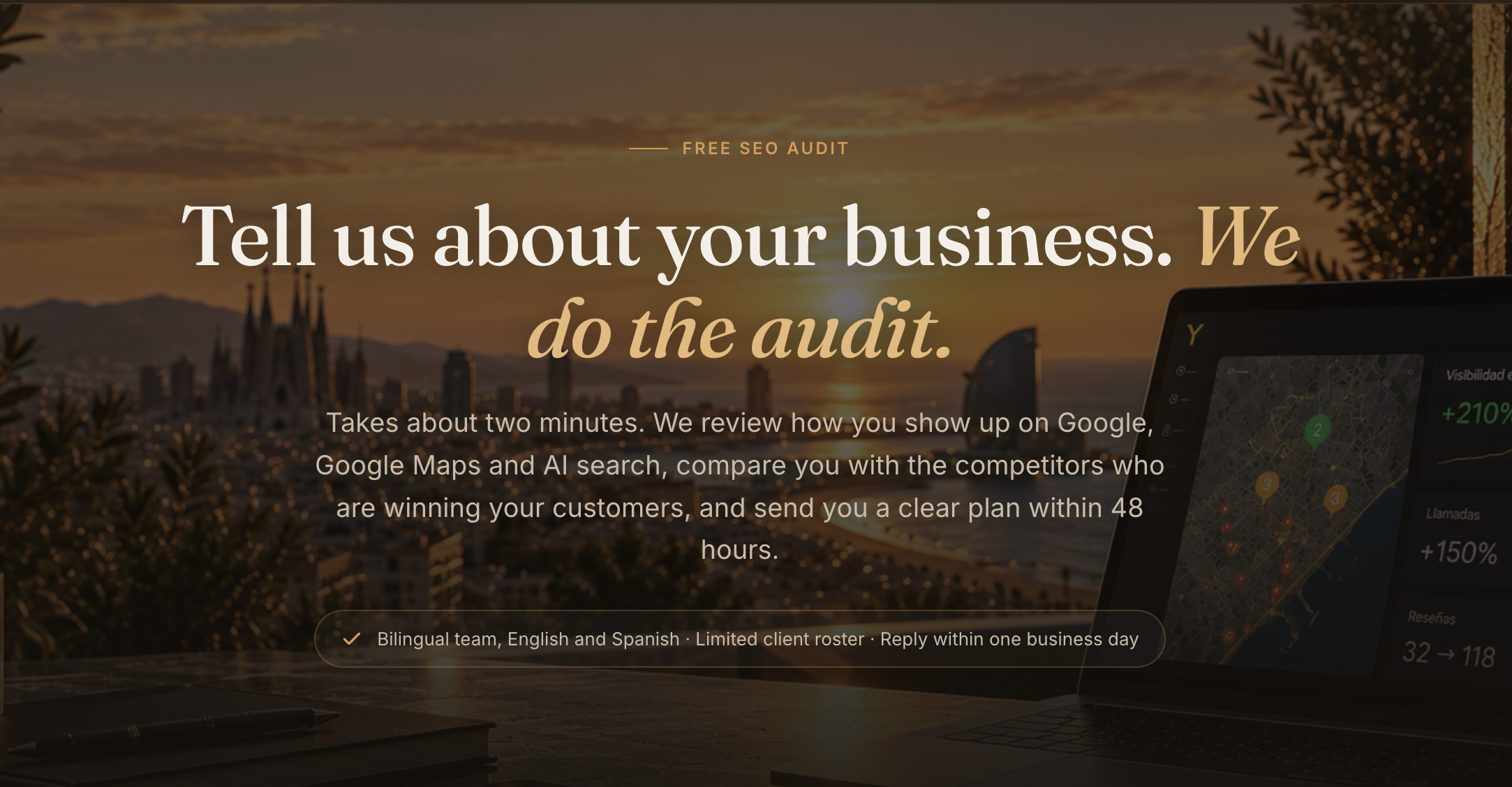
If you run a restaurant, clinic, dental practice, hotel, gym, veterinary clinic, home service company or shop in Florida, the first step is a look at where you stand today. We begin every engagement with a free SEO audit of your Google Business Profile, website, reviews and visibility in both languages.
You can see the full range on our services page, or go straight to the Growth plan if bilingual search is your priority.
Our perspective
Most local businesses we meet are not losing because their competitors are better. They are losing because their basics are scattered: a profile with the wrong category, a site with one page for everything, reviews nobody answers, and no presence at all in Spanish.
We believe local SEO works when Google Business Profile, Maps, website SEO, reviews and AI search visibility are worked together every month, not as separate projects. That is why our plans are built around the whole picture, and why we work English and Spanish as two separate searches, with their own keywords and content.
We also think an agency should be easy to check. That means monthly work you can verify, reporting you can read and no promises about ranking positions. We keep our portfolio limited so every business gets real attention from a team in your time zone.
Florida rewards the businesses that show up for everyone in their neighborhood. We want yours to be one of them.
YellowRock
FAQ
How much do local SEO services cost in Florida?
Price depends on how many locations you have, how competitive your market is, the size of your website and the services you need. Our plans do not have a published price, so the free audit is where we scope the work and the cost for your business.
How long does local SEO take to work?
Profile fixes can change how you appear within weeks, while content, links and reviews build over several months. Google says rankings depend on relevance, distance and prominence, and prominence is earned gradually. That is why we report on the work done each month rather than promising a position.
Do I need Spanish pages if my website is already in English?
If Spanish-speaking customers are part of your area, yes. About 31.4% of Floridians age 5 and older speak a language other than English at home, and most of them speak Spanish. They often search with different words than a translation would use, so Spanish pages need their own keyword research.
Can I pay Google to rank higher in Maps?
Not for the organic local results. Google states there is no way to request or pay for a better local ranking. Paid placement is a separate channel, Google Ads, which we offer as Turbo Google Ads, alongside the organic work.
Does local SEO help me show up in ChatGPT and Google AI answers?
It supports it. The same signals, an accurate profile, real reviews, clear pages and consistent mentions, feed both. Our Authority plan adds work focused on being named in AI answers.
Sources
- Tips to improve your local ranking on Google, Google Business Profile Help
- Guidelines for representing your business on Google, Google Business Profile Help
- What Is the Google Local Pack? How to Rank in the 3-Pack, Search Engine Land
- How AI is impacting local search and what tools you should use, Search Engine Land
- U.S. Census Bureau QuickFacts: Florida
- How many people in Florida speak a language other than English at home? USAFacts