

Dental SEO services get your practice to appear when someone nearby searches for a dentist: in the Google Maps results, in organic listings and increasingly in AI answers. The work that moves the needle is local: your Google Business Profile, service pages for each treatment, reviews and a site that converts a visit into a call. We run that work every month for practices in the U.S., in English and Spanish, so you reach the patients searching in either language.
Key Takeaways
- Dental SEO is a monthly program, not a one-off setup: Google Business Profile, treatment pages, reviews and tracking all have to move together.
- Most “no leads from Google” problems trace back to a few causes: a weak or mismatched profile, thin service pages, few recent reviews or a site that does not turn visits into calls.
- Measure calls, direction requests, form fills and booked new patients, not just rankings.
- In bilingual markets, separate Spanish and English keywords and pages open a patient pool that English-only SEO misses.
- Every YellowRock engagement starts with a free SEO audit, so you see where your practice stands before choosing a plan.
Table of Contents
- What dental SEO is and why it matters
- How Google decides which dentist to show
- What dental SEO services should include
- Why your dental practice is not getting leads from Google
- Bilingual dental SEO: the patients you may be missing
- How to measure whether dental SEO is working
- What dental SEO costs
- Our perspective
- Get a plan built around your practice
- FAQ
- Sources
What dental SEO is and why it matters
Dental SEO is the process of optimizing a practice’s online presence to earn more exposure in unpaid search results, which helps a dentist acquire new patients and drives visits to the website or calls to the front desk. Unlike ads, you do not pay per click, and the visibility compounds as your profile, reviews and pages build authority.
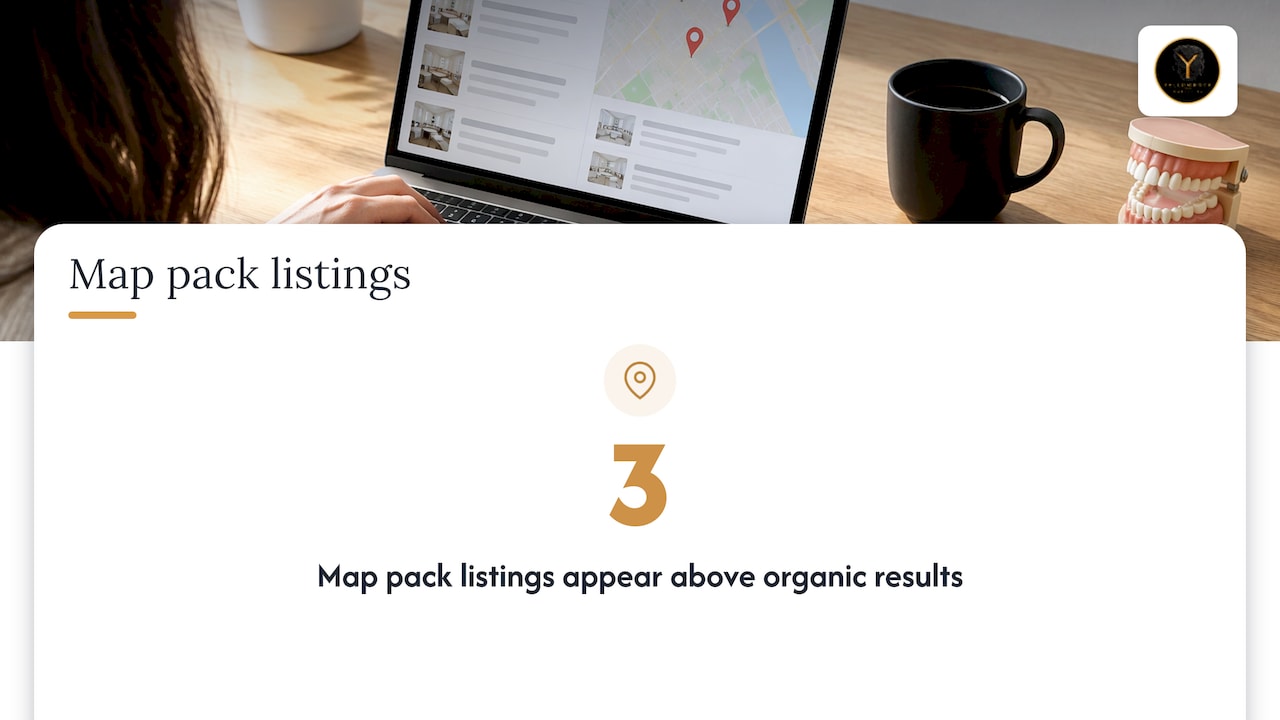
Patients search in a predictable way: “dentist near me,” “emergency dentist,” “Invisalign in [city],” “dental implants cost.” Each of those queries triggers a map pack with three listings above the organic results. If you are not in that pack, a large share of high-intent patients never see you.
How Google decides which dentist to show
Google’s own guidance says local results are based mainly on relevance, distance and prominence. Here is what each means for a dental practice:
| Factor | What it means | What you can do |
|---|---|---|
| Relevance | How well your profile and pages match the search | Choose precise categories, list every treatment, write a page per service |
| Distance | How close you are to the person searching | Nothing about the address itself, but accurate location data and neighborhood pages help |
| Prominence | How well known and trusted you are | Reviews and replies, quality links, consistent listings across the web |
Distance is fixed by where your chairs are. Relevance and prominence are where a monthly program earns its keep.
What dental SEO services should include
When you compare proposals, check that each of these pieces is covered. A package that is only “keywords and a report” leaves most of the leads on the table.
Google Business Profile optimization
Your profile is often the first thing a patient sees, sometimes before your website, and it has its own ranking potential. That makes it the core of a dental SEO strategy. Optimization covers primary and secondary categories, services, hours (including holiday and emergency hours), photos, posts, Q&A and the booking link.
If you want the full picture of how this works for patient-facing practices, our guide on local SEO for clinics walks through it.
Website and treatment pages
Google needs a page for each thing you want to rank for: implants, Invisalign, pediatric dentistry, emergency care, teeth whitening, sedation. A single “Services” page listing everything rarely wins any of them. Each page needs a clear title, the neighborhoods you serve, honest answers to common patient questions, a phone number that is easy to tap and a visible way to book. Our on-page SEO guide covers the factors in detail.
Reviews and reputation
Reviews feed prominence and influence whether a patient picks you after finding you. A review system means asking every satisfied patient at the right moment, making the link easy, and replying to every review. We build review systems as part of our plans.
Content and backlinks
Fresh, useful content shows Google that your site is active and earns links that raise authority. Our plans include weekly content with backlinks.
AI search visibility
Patients now ask ChatGPT, Gemini, Perplexity and Google AI Mode where to find a dentist. Appearing in those answers depends on clear, structured information about your practice and consistent signals across the web. Our Authority plan is built around visibility in AI search.
Tracking and reporting
Google Search Console is an excellent starting point for tracking SEO performance: it shows queries, click-through rates, rankings, indexing problems and mobile usability issues. A good provider pairs it with call tracking and profile insights, and shows you the monthly work in plain language.
Why your dental practice is not getting leads from Google
If the phone is quiet despite a decent website, work through these in order. Most practices find the answer in the first three.
- Your profile does not match what patients search. A generic category, missing services or an outdated description makes Google less sure you are relevant. Check that your primary category is the one that fits your main revenue treatments and that every service is listed.
- Your service pages are thin. If the only page mentioning implants is the home page, a competitor with a dedicated implants page will outrank you for it.
- Reviews are few or old. A practice with a long gap since its last review looks inactive next to one with steady recent feedback.
- Listings are inconsistent. Different phone numbers, suites or practice names across directories confuse both Google and patients.
- The site loses visitors. Slow mobile pages, buried phone numbers and long forms turn clicks into nothing. This is a conversion problem, not a ranking problem, and SEO can still fix it.
- You are invisible to part of your community. If a meaningful share of your neighborhood searches in Spanish and your site is English only, those patients are choosing someone else.
- Tracking is not set up. Without call tracking and Search Console you cannot tell whether leads are missing or simply not attributed.
A free audit settles which of these applies to you. Ours reviews your profile, site and local visibility, and it is where every YellowRock engagement starts.
Bilingual dental SEO: the patients you may be missing
In markets such as Miami, Orlando, Tampa, New York, New Jersey and Atlanta, many patients search in Spanish, or switch between languages depending on the query. Translating your English pages is not enough. Spanish speakers use different words (“dentista cerca de mí,” “limpieza dental,” “implantes dentales”), and Google treats the languages as separate searches.
Our approach is to research and write Spanish and English keywords, pages and content separately, so your practice shows up for both audiences in its area. Our Growth plan is built around this bilingual work. If your front desk already serves patients in both languages, your search presence should too.
How to measure whether dental SEO is working
Rankings alone can mislead. A top-three position for a term nobody books from is worth little. Track these monthly:
- Calls from your Google Business Profile and from your website, ideally with call tracking so you know which came from search.
- Direction requests and website clicks from the profile.
- Search Console queries and clicks for treatment terms such as implants, emergency dentist and Invisalign.
- Form submissions and online bookings.
- New patients booked, asking at intake how they found you.
- Review count, rating and recency.
SEO takes time to build. Expect the first months to establish foundations: profile cleanup, page fixes, review process. Visibility and lead growth follow as these compound. We do not promise ranking positions, because no one outside Google controls them; we show the work done each month and the numbers that result.
What dental SEO costs
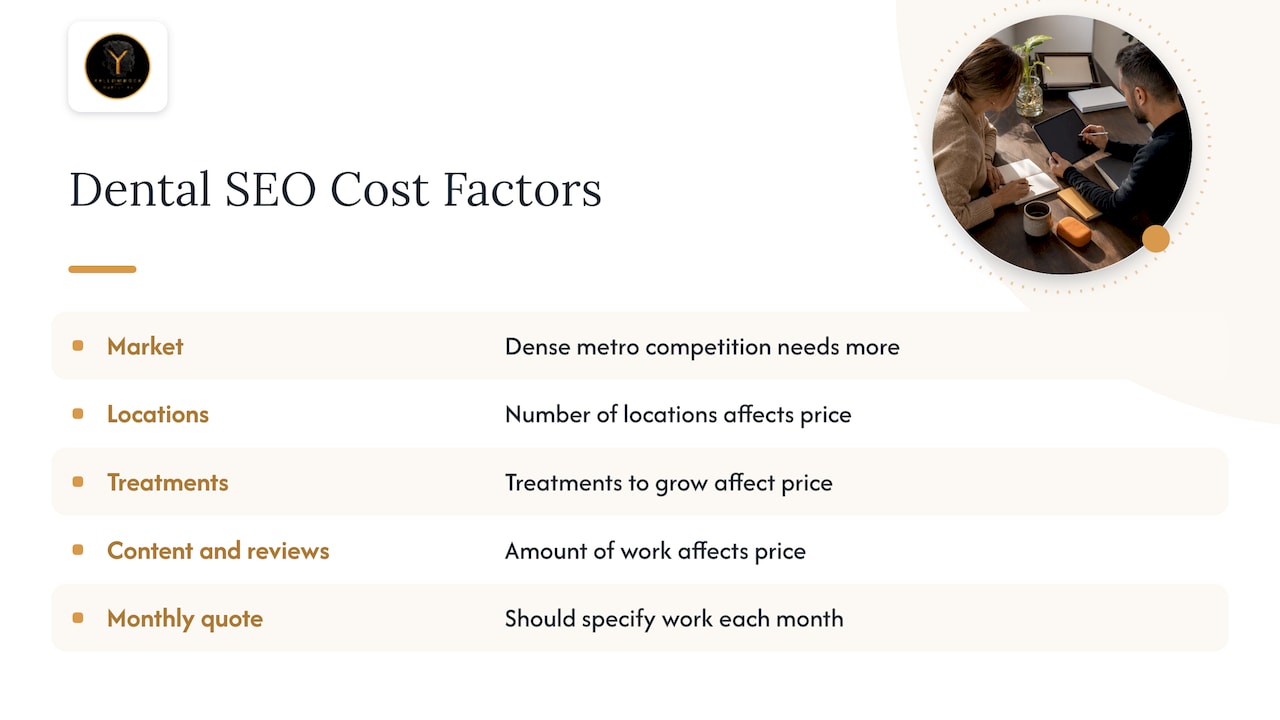
Prices vary with your market, the number of locations, the treatments you want to grow and how much content and review work is involved. A practice in a dense metro competing against several large groups needs more than a solo practice in a small town. Be careful with any quote that cannot say what happens each month in exchange for the fee.
Our Starter, Growth and Authority plans scale from local foundations to bilingual work to AI search visibility. Pricing is set after the free audit, once we know what your practice needs. If a new website is part of the problem, we also offer web design, and Turbo Google Ads can add paid visibility while organic results build.
Our perspective
Most dentists who tell us SEO did not work were buying activity: a monthly report with keyword positions and little else. Patients do not book from a position report. They book because your profile is complete, your treatment pages answer their questions, your reviews are recent and your phone number is one tap away.
We work the pieces together every month: Google Business Profile, Google Maps, website SEO, weekly content with backlinks, reviews and AI search visibility. We keep our client portfolio deliberately limited so each practice gets real attention, and our team works in your time zone.
Our difference is bilingual SEO. We handle English and Spanish keywords, pages and content separately, because the Hispanic patient in your area searches differently, and a translated page will not meet them. We make no promises about ranking positions. We show verifiable monthly work and transparent reporting.
YellowRock
Get a plan built around your practice
If you want a team to run this for you, our dental and clinic SEO program covers profile, maps, website, reviews, content and AI search visibility in English and Spanish. Start with the free audit and we will show you where your practice is losing patients today, then recommend between Starter, Growth and Authority.

You can see all our options on the services page, or start at yellowrockmarketing.com.
FAQ
How much does dental SEO cost?
It depends on your market, competition, number of locations and the scope of monthly work. Our plans do not have a published price, because we set the right plan after the free SEO audit shows what your practice needs. Ask any provider to list exactly what is delivered each month.
What is local SEO for dentists?
Local SEO focuses on appearing when nearby patients search for a dentist, especially in the Google Maps pack. It centers on your Google Business Profile, treatment and location pages, reviews and consistent listings. For a practice with one or a few offices, it is usually the highest-return part of SEO.
How long does dental SEO take to show results?
SEO builds over months, not days. Early work fixes the profile, pages and review process, and growth in calls and bookings follows as those improvements compound. We do not promise ranking positions, but we report the work and its effects every month.
Why am I not getting new patients from Google?
The common causes are a profile that does not match patient searches, thin treatment pages, few recent reviews, inconsistent listings and a site that does not convert visits into calls. For practices in bilingual areas, missing Spanish content is another frequent gap. A free audit identifies which apply to you.
Do I need Spanish content for my dental SEO?
If your community includes Spanish-speaking patients, yes. They search with different terms, and Google treats Spanish and English queries separately. Dedicated Spanish keywords and pages let your practice appear for both.
Sources
- Dental SEO: The Complete Guide to SEO for Dentists
- Pain-free SEO for Dentists
- Tips to improve your local ranking on Google