

Hotel SEO services make your own website the place travelers choose to book: they fix the technical basics, build pages for your location, rooms and amenities, and keep your Google Business Profile and reviews strong. For an independent or boutique hotel, B&B or vacation rental manager, the payoff is bookings that skip the commission and put the guest relationship in your hands. We built YellowRock Marketing around local businesses with a physical location, and hotels are one of the industries we work with every month, in English and in Spanish.
Key Takeaways
- Hotel SEO is the work of getting your own site found, understood and trusted on Google, so the booking happens on your site and not on a third-party platform.
- For most independent hotels, the Google Business Profile and the pages that describe your neighborhood, rooms and amenities do the most work.
- Good services are measured in booked stays and booking-page visits, not in promised ranking positions. Nobody can guarantee a position.
- If your guests search in Spanish as well as English, separate keywords and pages for each language reach guests a single translated site misses.
- Search is changing, with AI answers now sitting beside the classic results, so clear, factual pages and a well-kept profile matter more, not less.
Table of Contents
- What hotel SEO services actually do
- Why direct bookings are the real prize
- Start with the Google Business Profile
- Build a strategy around location, rooms and guest needs
- English and Spanish: two audiences, two sets of keywords
- Search is changing: AI answers and what to do about it
- How to measure whether it is working
- What to look for in a hotel SEO company
- Promo: hotel SEO with YellowRock
- Our perspective
- FAQ
- Sources
What hotel SEO services actually do
SEO stands for search engine optimization: improving your site and online presence so Google shows it to people searching for what you offer. For a hotel, those searches range from “hotels near the convention center” to “pet-friendly hotel in Savannah” to your own hotel’s name.
Hotel SEO covers on-site work (content, headings, meta descriptions, images) and off-site signals such as backlinks (links to your site from other sites), local listings and reviews, as one industry guide lays out. The goal is more traffic to your own website and more direct bookings. A plain-language guide adds that Google works in three stages, crawling, indexing and serving, and that no one sells or guarantees a ranking.
In practice, a hotel SEO service is a monthly bundle of five jobs:
- Technical foundations. Pages that load fast, work on phones and can be crawled, with a booking path that does not break.
- Local profile work. Your Google Business Profile, the listing that appears on Google Search and Google Maps.
- Content. Pages for rooms, amenities, neighborhoods, events and nearby attractions, written around what guests search for.
- Authority. Backlinks and consistent listings that tell Google you are a real, well-regarded property.
- Reporting. A monthly view of what changed and what it did for bookings.
If a proposal leaves out any of these, ask where the work is happening, because the five depend on each other. A strong profile that sends people to a slow booking page loses the guest at the last step.
Why direct bookings are the real prize
The usual argument is commission. Online travel agencies (OTAs), the booking platforms that list your rooms, typically charge 15% to 25% per booking, a range cited in guides from RMS Cloud and RoomRaccoon. The most-quoted version of that figure traces back to a 2016 study of 25,000 US hotels from the HSMAI Foundation, as this fact-check explains, so treat it as a range from a specific period, not a law of nature.
The second benefit is easier to overlook. A guest who books on your site is a guest you can email, welcome back and offer a better rate next spring. HotelRunner’s guide frames direct bookings as both profit and a direct relationship with the guest.
SEO also compounds. Rankings and pages you build this quarter keep working next quarter, which is why strong organic visibility can reduce how much you rely on paid channels over time, as RMS Cloud notes. That same timing is why SEO is a steady monthly effort and not a one-off project: SiteMinder describes it as a consistent process over an extended period.
Start with the Google Business Profile
When someone searches “hotels in Tampa,” the map and the hotel listings often appear before any website. Ahrefs points out that a hotel can show up twice on the first page, once in regular results and once in the map pack, and that ranking in the map pack requires an optimized Google Business Profile.
Cloudbeds calls the profile the single most important local SEO asset for a hotel, since it controls how you appear on Maps, Search and Google’s hotel results. A profile that works as a digital front desk includes:
- A description that names your neighborhood and real amenities.
- Authentic, high-resolution photos of rooms, lobby, breakfast, pool and exterior.
- Regular posts about offers and nearby events.
- Answers to the questions guests ask most.
- A booking link that leads to your own booking engine.
That last item deserves attention. Google’s help pages explain that free booking links show your rates and availability in Search and Maps, and that the booking page URL must take travelers to your own website, not to a social page or an OTA. Only hotels that are bookable online are eligible. Connecting this correctly is a small job with a large effect on direct reservations.
Reviews belong here too. Recent, specific reviews with a reply from the owner or manager tell both Google and the next guest that the property is active and cared for. A review system makes asking for them routine after check-out, instead of an occasional push.
We go deeper on how a profile earns map visibility in our guide to local SEO strategy for Google Maps.
Build a strategy around location, rooms and guest needs
A hotel is not a generic business, and its keywords are not generic either. Cloudbeds suggests starting with guest segments, since leisure, business, event and long-stay travelers search differently, then matching each to a page type:
| Guest intent | Example search | Page that answers it |
|---|---|---|
| Exploring | “luxury hotels in Miami Beach” | Destination or neighborhood guide |
| Comparing | “hotel with rooftop pool Miami” | Room and amenity pages |
| Ready to book | “book boutique hotel downtown Atlanta tonight” | Landing page with a clear booking path |
| Nearby | “hotel near Fenway Park” | Location pages tied to landmarks |
RMS Cloud recommends clustering keywords by location and amenities, such as neighborhoods, nearby attractions, pet-friendly rooms, family suites or spa facilities, and using long-tail phrases like “family hotels near Central Park.” Long-tail means longer, more specific searches, which usually come from guests who are closer to deciding.
A worked example
Imagine a 40-room boutique hotel in Wynwood, Miami. Instead of one page called “Rooms,” it gets a page per room type, each describing the actual view, bed and who it suits. A page covers Wynwood Walls and the neighborhood’s galleries and restaurants, and another covers the hotel’s pet policy and rooftop. Each page targets one clear search and links to the booking page. The profile points to the same booking engine. When a guest searches “pet-friendly hotel Wynwood,” there is a page that answers precisely that.
Our hotel and tourism SEO page shows how we apply this to properties, and our walkthrough on keyword research explains how to find searches worth targeting.
English and Spanish: two audiences, two sets of keywords
In Miami, Orlando, Tampa, New York and Atlanta, a large share of guests, and of the staff who plan their trips, search in Spanish. A site that only offers an automatic translation tends to match neither language well, because people do not search the way a translator writes.
Our approach is to work English and Spanish keywords, pages and content separately, so the hotel shows up for the English-speaking and the Hispanic traveler in its area. A guest who searches “hotel con piscina cerca de Brickell” should land on a page written for that search, not a literal copy of an English page.
Search is changing: AI answers and what to do about it
Travelers now get hotel suggestions from AI tools as well as the ten blue links. Google has also announced hotel booking inside AI Mode, as one travel-tech report describes for August 2026. SEO is not going away, but its scope is widening.
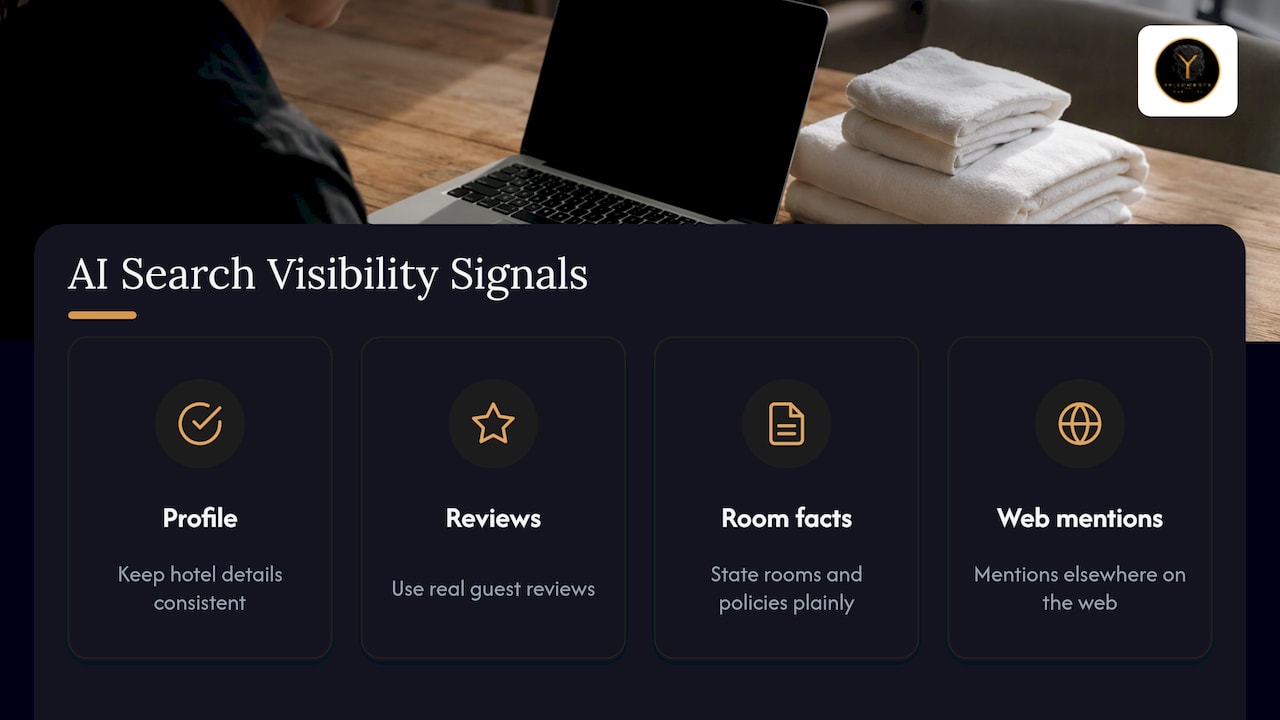
The practical response is not a new trick. AI systems draw on clear, accurate, well-structured pages and trustworthy signals: a consistent profile, real reviews, facts about your rooms and policies stated plainly, and mentions elsewhere on the web. That is the same foundation as classic hotel SEO, with answers written so a person or an engine can lift them directly. We include visibility in ChatGPT, Gemini, Perplexity and Google AI Mode in our work for exactly this reason.
How to measure whether it is working
Rankings are a means. What you care about is whether the site brings people who book. Track a short list each month:
- Organic visits to the booking page, in Google Analytics.
- “Book Now” clicks and booking revenue, which can be tracked with Google Tag Manager, as one practitioner guide recommends.
- Profile performance: impressions, calls, direction requests and booking-link clicks from the Google Business Profile, which RMS Cloud suggests reviewing monthly.
- Branded versus non-branded search: guests who typed your name versus guests who typed a need you meet.
- Review count and rating over time.
Seasonality matters. Compare December to last December, not December to October.
What to look for in a hotel SEO company
You will see many agencies and directories when you search for this. A few criteria separate useful partners from noise:
- No ranking guarantees. Google does not sell rankings, and a team that promises position one is promising something it does not control.
- Verifiable monthly work. You should be able to see what was done, what changed and what it did for bookings.
- Local knowledge. Someone who understands your market, your guests and your time zone.
- Attention. A team with room to answer you, not an overloaded one.
- Language fit. If your market is bilingual, ask how Spanish content is created.
- A clear scope: profile, website, content, reviews and AI visibility planned together.
What do hotel SEO services cost? Pricing varies with the size of the property and the market, and any figure from a directory is a snapshot. The fair comparison is the monthly fee against the commission on the bookings it shifts to your site. One industry estimate, reported in Hotel.Report, puts the full cost of direct online distribution at around 4.25% to 4.5% of revenue, website and marketing included, against OTA commissions that can exceed 30% once extra fees are added. It is an industry estimate and not a quote, but it shows why the math often favors the direct channel.
Promo: hotel SEO with YellowRock
We are a local SEO agency for independent businesses with a physical location, and hotels, boutique hotels, B&Bs and vacation rental managers are among the industries we specialize in. Our work combines Google Business Profile optimization, Google Maps rankings, website SEO, weekly content with backlinks, review systems and AI search visibility, in English and Spanish with separate keywords and content for each. Reporting is transparent, we make no promises of ranking positions, and we keep our client portfolio deliberately limited so each business gets real attention.

Every engagement starts with a free SEO audit. From there you can choose between our Starter, Growth and Authority plans, and web design is available if your booking site needs rebuilding. If you manage short-term rentals, see our page on SEO for holiday rentals. You can start at yellowrockmarketing.com.
Our perspective
Hotels lose direct bookings in small, fixable places: a Google Business Profile that links to a third party, a room page that says “deluxe king” and nothing a guest can picture, a Spanish-speaking traveler who lands on an English-only page.
We believe local SEO for a hotel works when the profile, the website, the reviews and AI visibility are planned as one system and worked every month. That is why our plans put them together, and why we treat English and Spanish as separate searches with their own keywords and pages, not as a translation job.
We also think an agency owes you clarity. We do not promise ranking positions, we report the work we did each month, and we keep our portfolio limited so your property is not one of hundreds. Our team works in the U.S., in your time zone, with a focus on the East Coast markets where many independent hotels compete for the same travelers.
YellowRock
FAQ
How long does hotel SEO take to work?
SEO is a process built over months, not days, and results depend on your market, competition and starting point. Profile fixes and booking-link changes can show up sooner, while content and authority build gradually. Track booking-page visits and direct reservations month over month.
Is SEO being phased out because of AI search?
No. AI answers now appear alongside classic results, and they draw on the same kinds of signals: accurate pages, a consistent profile and real reviews. Strong hotel SEO prepares you for both, and we include AI search visibility in our work.
Do I need a new website for hotel SEO?
Not always. If your pages load fast, work on phones and have a clear booking path, the work can start with content and your profile. If the site is hard to update or slow, a redesign can be the faster route, and we offer web design for that.
Can SEO replace OTAs completely?
The aim is to grow your direct share, not to remove any channel overnight. SEO builds demand on your own site, so over time more guests choose to book with you directly.
Sources
- Guestpoint: Hotel SEO overview
- Lodging Engine: What Is Hotel SEO?
- RMS Cloud: Complete Guide to SEO for Hotels & Direct Bookings
- RoomRaccoon: What is Hotel SEO?
- Lumina Frontier: Hotel marketing statistics
- HotelRunner: What is Hotel SEO?
- SiteMinder: Hotel SEO Ultimate Guide
- Ahrefs: SEO for Hotels
- Cloudbeds: Hotel SEO Tips
- PHPTravels: Google AI Mode hotel booking
- Gord Collins: Hotel SEO strategy
- Hotel.Report: direct online channel costs